lichess.org
Donate

Why Are People Good At Chess?

@simoncov said in #10:

In particular, I can think of good answers to the deficiencies proposed in your Conclusion that build on Chunking with other factors. For example, candidate moves could be of better quality with better and more chunks remembered by masters and a system of priorities to govern which are the suggested moves should be at the top of the list.

Intriguing. Thank you for responding.

You say that better/more chunks can produce better quality candidate moves. But saying better chunks means better candidate moves doesn't explain anything. Because what does 'better' mean? It's very vague.

It's like saying chess skill develops because people play 'better moves'. Yes that's true, but it doesn't give an answer, it's just stating an obvious fact.

Also how does 'more' chunks translate to better candidate moves?

You also talk of a 'system of priorities' to decide a move. But what are the 'system of priorities'?

@simoncov said in #10: > In particular, I can think of good answers to the deficiencies proposed in your Conclusion that build on Chunking with other factors. For example, candidate moves could be of better quality with better and more chunks remembered by masters and a system of priorities to govern which are the suggested moves should be at the top of the list. Intriguing. Thank you for responding. You say that better/more chunks can produce better quality candidate moves. But saying better chunks means better candidate moves doesn't explain anything. Because what does 'better' mean? It's very vague. It's like saying chess skill develops because people play 'better moves'. Yes that's true, but it doesn't give an answer, it's just stating an obvious fact. Also how does 'more' chunks translate to better candidate moves? You also talk of a 'system of priorities' to decide a move. But what are the 'system of priorities'?

I didn't want to write too long a comment, I'll elaborate a little on this particular example.

First, I think chess is a complex combination of different thinking modes. This is one of the reasons it is so perennially intriguing and also why it is difficult to improve at. Memory Chunking seems likely to be part of the puzzle providing a foundation for pattern recognition and intuition but it seems that there must also be fuzzy logic judgement and raw calculation sitting on top of that.

In this particular example, Memory Chunking provides some building blocks that may be the foundation of a masters positional understanding. Recognizing obvious chunks like The Two Bishops and particular pawn structures but also more subtle elements of the position that recall previous games and analysis could conceivably be a fundamental part of how masters assess positions. Much of this also probably occurs subconsciously, making it difficult to difficult to articulate in a way that weaker players can put into action. In this model each of the Chunks that the master recognizes would suggest certain ideas and evaluation points. Additionally a master will be able to recognize which of these elements are more pertinent to the current position again based on their memory of similar positions and an understanding on which elements are more important.

So, when I say "better chunks" I mean that a master has learnt more chunks that each suggest ideas that are useful in practice and more likely to be objectively good. As a vastly over simplified example, when you have more piece activity in the centre then it is a good idea to push the pawns in the centre. For masters they have memorized more objectively good examples like this and are able to recall them subconsciously and thus intuitively be able to understand a position.

So, knowing more chunks and chunks that are more likely to lead to good ideas (and correct evaluations) leads to better candidate moves. I feel that strong players intuitively reject many weak moves that I have to check with brute calculation. This could be because they are subconsciously recognizing patterns (chunks) so that they never even consciously consider those moves. Or that they only consider stronger moves as candidates because they intuitively recognise what is pertinent in a position and don't need to consider those weaker moves.

By "system of priorities" I simply mean that a master is able to order the list of candidate moves better than weaker players so that practically and objectively better moves are more likely to be near the top of the list compared to weaker players. Again, an oversimplified example would be Checks, Captures, and Threats, the "system of priorities" tells us to consider moves that are checks first and so on. I suppose that a master knows more subtle priorities and has learnt more patterns and their priorities to be able to more quickly determine what is pertinent in any given position subconsciously. To elaborate, that would mean that the Memory Chunks that they remember contain also some kind of priority that allows the output ideas to be ranked so that the master is able to intuitively grasp which are the most important candidate moves in a position.

Of course I think that everybody would agree that having good candidate moves is only part of the puzzle? The master still needs to make a judgement between those candidates and do some calculation to check that it is actually objectively relevant to the current position. Chess is concrete. Nevertheless, some form of intuitive pattern recognition forms foundational part of the masters thinking process and Memory Chunking provides a good explanation for that part of the puzzle even though there are clearly other elements not explained by Chunking alone.

One reason I find this interesting because it is relevant to improving in chess. My feeling has long been that it is difficult to improve because there are simply so many different elements to chess so that it is difficult to not become mentally overloaded in the moment. Focusing on one area can be detrimental to other areas. Strong players have managed to automate many of these processes so that they work well subconsciously. In order to improve players must also try to do that, but how? I think there are many good answers but one example is analysing ones own games (initially without the engine). Conceivably one way that helps is by teaching us "better" and more Chunks. Of course that is just a hypothesis that would need a lot of work to test but nevertheless hopefully interesting food for thought. Thanks!

I didn't want to write too long a comment, I'll elaborate a little on this particular example. First, I think chess is a complex combination of different thinking modes. This is one of the reasons it is so perennially intriguing and also why it is difficult to improve at. Memory Chunking seems likely to be part of the puzzle providing a foundation for pattern recognition and intuition but it seems that there must also be fuzzy logic judgement and raw calculation sitting on top of that. In this particular example, Memory Chunking provides some building blocks that may be the foundation of a masters positional understanding. Recognizing obvious chunks like The Two Bishops and particular pawn structures but also more subtle elements of the position that recall previous games and analysis could conceivably be a fundamental part of how masters assess positions. Much of this also probably occurs subconsciously, making it difficult to difficult to articulate in a way that weaker players can put into action. In this model each of the Chunks that the master recognizes would suggest certain ideas and evaluation points. Additionally a master will be able to recognize which of these elements are more pertinent to the current position again based on their memory of similar positions and an understanding on which elements are more important. So, when I say "better chunks" I mean that a master has learnt more chunks that each suggest ideas that are useful in practice and more likely to be objectively good. As a vastly over simplified example, when you have more piece activity in the centre then it is a good idea to push the pawns in the centre. For masters they have memorized more objectively good examples like this and are able to recall them subconsciously and thus intuitively be able to understand a position. So, knowing more chunks and chunks that are more likely to lead to good ideas (and correct evaluations) leads to better candidate moves. I feel that strong players intuitively reject many weak moves that I have to check with brute calculation. This could be because they are subconsciously recognizing patterns (chunks) so that they never even consciously consider those moves. Or that they only consider stronger moves as candidates because they intuitively recognise what is pertinent in a position and don't need to consider those weaker moves. By "system of priorities" I simply mean that a master is able to order the list of candidate moves better than weaker players so that practically and objectively better moves are more likely to be near the top of the list compared to weaker players. Again, an oversimplified example would be Checks, Captures, and Threats, the "system of priorities" tells us to consider moves that are checks first and so on. I suppose that a master knows more subtle priorities and has learnt more patterns and their priorities to be able to more quickly determine what is pertinent in any given position subconsciously. To elaborate, that would mean that the Memory Chunks that they remember contain also some kind of priority that allows the output ideas to be ranked so that the master is able to intuitively grasp which are the most important candidate moves in a position. Of course I think that everybody would agree that having good candidate moves is only part of the puzzle? The master still needs to make a judgement between those candidates and do some calculation to check that it is actually objectively relevant to the current position. Chess is concrete. Nevertheless, some form of intuitive pattern recognition forms foundational part of the masters thinking process and Memory Chunking provides a good explanation for that part of the puzzle even though there are clearly other elements not explained by Chunking alone. One reason I find this interesting because it is relevant to improving in chess. My feeling has long been that it is difficult to improve because there are simply so many different elements to chess so that it is difficult to not become mentally overloaded in the moment. Focusing on one area can be detrimental to other areas. Strong players have managed to automate many of these processes so that they work well subconsciously. In order to improve players must also try to do that, but how? I think there are many good answers but one example is analysing ones own games (initially without the engine). Conceivably one way that helps is by teaching us "better" and more Chunks. Of course that is just a hypothesis that would need a lot of work to test but nevertheless hopefully interesting food for thought. Thanks!

@simoncov

Thank you for your thoughtful response. Good stuff for me to think about!

@simoncov Thank you for your thoughtful response. Good stuff for me to think about!

My pleasure, was useful for organising my own thinking.

My pleasure, was useful for organising my own thinking.

Maybe chess players tend to misunderstand chunking as a theory of why people are good at chess, which not accurate.

Chunking theory is a universal memory theory that applied to all mental functioning, chess being just one of, that was used in psychological experiments in the 1970s and 1980s. Other than that, there is no connection with chess, other than chunking as a universal psychological theory is applied to chess.

Chunking is not applied to chess, chess is applied to chunking theory, and actually when chess players disagreeing with Chunking theory is more a sign of chess players disagreeing with psychology and science of expertise in general. As the current psychological consensus of what makes great chess players is not something that competitive chess players would get behind (otherwise they probably would give up competitive chess).

@simoncov currently chunking theory is outdated, and if one was interesting in psychological research on chess, would be 'predictive processing', an adaption of chunking.

So according to predictive processing, the human mind automatically makes the best decision for the person, giving the sense perception, and previously determined Chunks (higher order rules). So there is actually no such thing as a mistake (blunder), but the blunder is in fact the best decision the mind could make with their current information and understanding.

Currently chess in no longer an interesting area of psychology (other than developmental psychology and education theory).

And most of your ideas, are more of how one might program a computer to play chess, but does not match current theories of mind, such and Fodor's compartmental mind, eliminativism, predictive processing, or even quantum mind theories, all which clearly differ from how top chess players and coaches understand their own mind. But somewhat the point of science of mind, not to use intro-spection as informative.

Maybe chess players tend to misunderstand chunking as a theory of why people are good at chess, which not accurate. Chunking theory is a universal memory theory that applied to all mental functioning, chess being just one of, that was used in psychological experiments in the 1970s and 1980s. Other than that, there is no connection with chess, other than chunking as a universal psychological theory is applied to chess. Chunking is not applied to chess, chess is applied to chunking theory, and actually when chess players disagreeing with Chunking theory is more a sign of chess players disagreeing with psychology and science of expertise in general. As the current psychological consensus of what makes great chess players is not something that competitive chess players would get behind (otherwise they probably would give up competitive chess). @simoncov currently chunking theory is outdated, and if one was interesting in psychological research on chess, would be 'predictive processing', an adaption of chunking. So according to predictive processing, the human mind automatically makes the best decision for the person, giving the sense perception, and previously determined Chunks (higher order rules). So there is actually no such thing as a mistake (blunder), but the blunder is in fact the best decision the mind could make with their current information and understanding. Currently chess in no longer an interesting area of psychology (other than developmental psychology and education theory). And most of your ideas, are more of how one might program a computer to play chess, but does not match current theories of mind, such and Fodor's compartmental mind, eliminativism, predictive processing, or even quantum mind theories, all which clearly differ from how top chess players and coaches understand their own mind. But somewhat the point of science of mind, not to use intro-spection as informative.

Basically any current psychology of chess, will diminish chess as a kids game, that one learns mostly patterns only useful to chess, than does not transfer to other skills (Except during the formative years of brain development in children.

Hence why any foundation, serious donor, who has read the scientific literature on chess, refuses to support adult competitive chess, and only support chess for elementary and middle school in 'title I' (low socio-economic status), other than that, chess has almost no purpose or benefit, and chunking does in fact largely explain the path novice to expert in chess, with the estimated 10,000 hours of deliberate practice to 'memorize / internalize' the hundreds of thousands of patterns.

And the general consensus of psychology that dedicating so much time to mastering chess patterns as an adult, is actually an indication of self-destructive, irrational behavior, of people who have a problem relating to other people. Hence the top competitive chess players (like CEOs and politicians and serious criminals) tend to be autists, psychopaths, sadists, or other disorders that gives the adult chess player some irrational pleasurable stimulus from winning at chess, as a sublimation for an inablility to win at life.

Chess players and promoters have to note, and struggle with the current psychological evidence against chess. Hence most players or trainers completely react psychology, or dishonestly distort the science to try to profit off of chess (basically alwas fails).

Basically any current psychology of chess, will diminish chess as a kids game, that one learns mostly patterns only useful to chess, than does not transfer to other skills (Except during the formative years of brain development in children. Hence why any foundation, serious donor, who has read the scientific literature on chess, refuses to support adult competitive chess, and only support chess for elementary and middle school in 'title I' (low socio-economic status), other than that, chess has almost no purpose or benefit, and chunking does in fact largely explain the path novice to expert in chess, with the estimated 10,000 hours of deliberate practice to 'memorize / internalize' the hundreds of thousands of patterns. And the general consensus of psychology that dedicating so much time to mastering chess patterns as an adult, is actually an indication of self-destructive, irrational behavior, of people who have a problem relating to other people. Hence the top competitive chess players (like CEOs and politicians and serious criminals) tend to be autists, psychopaths, sadists, or other disorders that gives the adult chess player some irrational pleasurable stimulus from winning at chess, as a sublimation for an inablility to win at life. Chess players and promoters have to note, and struggle with the current psychological evidence against chess. Hence most players or trainers completely react psychology, or dishonestly distort the science to try to profit off of chess (basically alwas fails).

@defense57 i wrote a blog on Kotov and history of analysis trees. But the evidence is that Kotov's theory more accurately describes how the computer understands chess, not how humans do.
Only some theories of mind like predictive processing, hold the mind does a Kotov like process, but subconsciously, and like Jerry Fodor's compartmental mind, the part of the mind that actually processes is different from the part of the mind that describes how the mind function.
And the famous Libet experiment showing that the mind decides to act, before the person realized consciously the mind is going to act.

So need to separate chess players, and how they understand expertise and their mind works, with current psychology that demonstrates the near impossibility of one understanding their own mind.

https://adjva4.dpdns.org/@/DIAChessClubStudies/blog/kotovs-chess-candidate-moves--analysis-trees/RCBgdcrD

@defense57 i wrote a blog on Kotov and history of analysis trees. But the evidence is that Kotov's theory more accurately describes how the computer understands chess, not how humans do. Only some theories of mind like predictive processing, hold the mind does a Kotov like process, but subconsciously, and like Jerry Fodor's compartmental mind, the part of the mind that actually processes is different from the part of the mind that describes how the mind function. And the famous Libet experiment showing that the mind decides to act, before the person realized consciously the mind is going to act. So need to separate chess players, and how they understand expertise and their mind works, with current psychology that demonstrates the near impossibility of one understanding their own mind. https://adjva4.dpdns.org/@/DIAChessClubStudies/blog/kotovs-chess-candidate-moves--analysis-trees/RCBgdcrD

Very interesting post, thanks for sharing! We're building on ideas like this at https://hyperchess.ai to build a conversational engine and chess coach.

The first point about "compressing" binary number strings using decimal numbers illustrates the very interesting concept (to me) of Kolmogorov complexity (https://en.wikipedia.org/wiki/Kolmogorov_complexity - how few bytes can you use to express an idea? e.g. "repeat 01 fifty times") and a very new piece of research that coins the more general concept of epiplexity (https://arxiv.org/abs/2601.03220 - how much local structure can be extracted by a best-case model from some set of training data?).

Our theory at Hyperchess is exactly what the linked research here implies - natural language can express ideas on the board in far fewer bytes than literal descriptions of the position or best lines, so it's a more efficient medium/language to operate in.

Static eval for Stockfish and non-neural-network-based engines is better than most humans these days, but even before that was the case, it was already beating humans by relying on scaling tree search many order of magnitude beyond what any human can hope to match. AlphaZero-based models search an order of magnitude fewer nodes to produce a same-strength eval, and their architecture implies that they do learn their own "internal" language space under the hood, but we have no mechanism for translating that to human languages. So the problem we're solving at Hyperchess is aligning AlphaZero-style models to human language spaces, so we can understand exactly what they're thinking despite being so much stronger than humans. Then we'll get the benefits of both worlds!

Cool stuff :)

Very interesting post, thanks for sharing! We're building on ideas like this at https://hyperchess.ai to build a conversational engine and chess coach. The first point about "compressing" binary number strings using decimal numbers illustrates the very interesting concept (to me) of Kolmogorov complexity (https://en.wikipedia.org/wiki/Kolmogorov_complexity - how few bytes can you use to express an idea? e.g. "repeat 01 fifty times") and a very new piece of research that coins the more general concept of epiplexity (https://arxiv.org/abs/2601.03220 - how much local structure can be extracted by a best-case model from some set of training data?). Our theory at Hyperchess is exactly what the linked research here implies - natural language can express ideas on the board in far fewer bytes than literal descriptions of the position or best lines, so it's a more efficient medium/language to operate in. Static eval for Stockfish and non-neural-network-based engines is better than most humans these days, but even before that was the case, it was already beating humans by relying on scaling tree search many order of magnitude beyond what any human can hope to match. AlphaZero-based models search an order of magnitude fewer nodes to produce a same-strength eval, and their architecture implies that they do learn their own "internal" language space under the hood, but we have no mechanism for translating that to human languages. So the problem we're solving at Hyperchess is aligning AlphaZero-style models to human language spaces, so we can understand exactly what they're thinking despite being so much stronger than humans. Then we'll get the benefits of both worlds! Cool stuff :)

DIAChessClubStudies There is a pervasive misunderstanding of Kotov's method that began a few years ago with a book about chess thinking by a popular chess author. Here is the real deal. The purpose of Kotov's exercises was to think more creatively (e.g., select 6 candidate moves). To think more consistently. That is, you analyze one line and move on to the next. You don't go back. This is the way modern GMs describe their thinking process. You learn to analyze more deeply by analyzing at least one move past where you believe the tactics have been resolved. You analyze in tree variation to increase visualization skills and to learn about what sort of things you are missing. Kotov never said in any way shape or form that you should train yourself to think in tree variations. This was an exercise to develop chess thinking skills. It also moves one away from just studying tactics but analyzing real games where sometimes there are tactics and sometimes there are not -- it integrates tactics with positional judgment. It's the same problem as those who would tell you that studying tactics over and over again is what research tells you should do become a better chess player. It's simply not true.

DIAChessClubStudies There is a pervasive misunderstanding of Kotov's method that began a few years ago with a book about chess thinking by a popular chess author. Here is the real deal. The purpose of Kotov's exercises was to think more creatively (e.g., select 6 candidate moves). To think more consistently. That is, you analyze one line and move on to the next. You don't go back. This is the way modern GMs describe their thinking process. You learn to analyze more deeply by analyzing at least one move past where you believe the tactics have been resolved. You analyze in tree variation to increase visualization skills and to learn about what sort of things you are missing. Kotov never said in any way shape or form that you should train yourself to think in tree variations. This was an exercise to develop chess thinking skills. It also moves one away from just studying tactics but analyzing real games where sometimes there are tactics and sometimes there are not -- it integrates tactics with positional judgment. It's the same problem as those who would tell you that studying tactics over and over again is what research tells you should do become a better chess player. It's simply not true.

@simoncov

In this particular example, Memory Chunking provides some building blocks that may be the foundation of a masters positional understanding. Recognizing obvious chunks like The Two Bishops and particular pawn structures but also more subtle elements of the position that recall previous games and analysis could conceivably be a fundamental part of how masters assess positions.

We need to know what a chunk is.

A chunk/template is a very specific concept when applied to chess. It is a particular arrangement of pieces. Simon and Chase proposed that chess skill develops as more are learned and stored as a chess vocabulary. However, they glossed over the issue of how chunks actually translate to making moves.

Patterns are not necessarily chunks. Chunks are a type of pattern, but patterns aren't always chunks.

In this model each of the Chunks that the master recognizes would suggest certain ideas and evaluation points. Additionally a master will be able to recognize which of these elements are more pertinent to the current position again based on their memory of similar positions and an understanding on which elements are more important.

Gobet introduced Template theory to deal with the fact that interference after viewing a chess position did not impact memory. So he said that basically there were bigger chunks (templates) in long term memory and that those templates could link to other templates and also semantic/conceptual info.

Gobet also added things to his template theory ad hoc. Such as talking about templates can suggest conceptual plans. But this isn't explained by his theory.

Like he just added everything to the basket. Templates just tell you answer like a magic word.

But he didn't explain how semantic/conceptual info develops from templates.

Another problem is that chunks/templates can't be viewed in isolation. Take the two bishops, whether their good or bad depends on the position. Two Bishops by themselves can't suggest anything.

Take the Euwe game I showed:
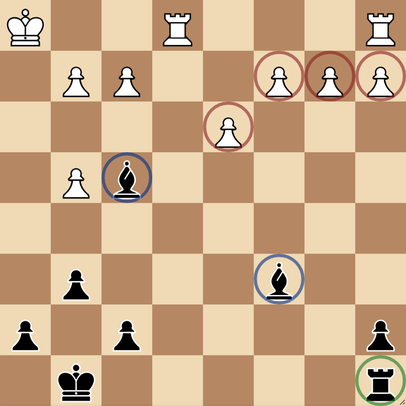
Chess Patterns.png

  1. The bishop pair can suggest 2 things here: try to attack the king or to try to form a blockade against the queenside pawns. But notice this is in context of surrounding factors. Also these are high level conceptual ideas, not the simple 'productions' which were proposed to be the basis for move suggestion.

  2. Euwe had the idea of playing Rb8-Rb5 and h5 to open the h-file. The rook is by itself. How does the rook get chunked? Chunks are supposed to be an element of memory. If patterns are intermingled then this goes against this completely because chunks are supposed to be independent and composed of subparts that only link to a single chunk.

The need to synthesize different information in chess is a blow to the idea that you just need to learn more chunks to become more skilled.

Dennis Holding (developed SEEK theory of chess) criticized chunks because they lacked independent functionality. (they can't suggest moves on their own). Gobet actually responded to this in a paper, saying that a pawn structure can suggest a move on its own. ( example from me is French defense pawn structure as white can suggest f4 to attack on kingside).

But this is a very simple example. And f4 is not always a good move, you have to keep in mind the f2 g1 diagonal. Plus sometimes its better to reserve f4 for a knight instead (f4 can also block the c1 bishop).

The point here is that chunks couldn't be independent and the the idea that a chunk can suggest a move 'on its own' is false. If we say that the french pawn structure 'suggests' f4 than this doesn't explain chess skill. If there are about 7 chunks in short term memory and they 'suggest' a move each, the how does this mesh with the fact that masters look at only a few initial moves? and also have a high level conceptual understanding of the position after only a brief look at the position?

The chunks in Simon and Chase's study were said to be pieces with relations between them: (attack, defense, color, piece type, proximity). But chess games tell a story. They are not just memorized relations of attack relations, defense relations etc.. That was a very unrealistic way of conceiving of chess.

Now if you say its patterns recognition that is the reason rather then chunks then that is plausible.

My point is that chunks are a specific concept. They aren't just patterns generally, they actually posit a specific arrangement of pieces that have been learned and that these chunks are linked to productions that can suggest a move.

So we can say that pattern recognition is an important skill (still the question of how to define a pattern, and how they develop).

I could see chunks as useful for basic tactical ideas or more simple concepts. Maybe in this case it could suggest a tactical move or idea, and then this idea could be checked to see that it works.

But the claims made by the proponents in this article, that the learning of chunks/templates is the foundation of chess skill is clearly wrong.

@simoncov >In this particular example, Memory Chunking provides some building blocks that may be the foundation of a masters positional understanding. Recognizing obvious chunks like The Two Bishops and particular pawn structures but also more subtle elements of the position that recall previous games and analysis could conceivably be a fundamental part of how masters assess positions. We need to know what a chunk is. A chunk/template is a very specific concept when applied to chess. It is a *particular arrangement of pieces*. Simon and Chase proposed that chess skill develops as more are learned and stored as a chess vocabulary. However, they glossed over the issue of how chunks actually translate to making moves. Patterns are not necessarily chunks. Chunks are a type of pattern, but patterns aren't always chunks. >In this model each of the Chunks that the master recognizes would suggest certain ideas and evaluation points. Additionally a master will be able to recognize which of these elements are more pertinent to the current position again based on their memory of similar positions and an understanding on which elements are more important. Gobet introduced Template theory to deal with the fact that interference after viewing a chess position did not impact memory. So he said that basically there were bigger chunks (templates) in long term memory and that those templates could link to other templates and also semantic/conceptual info. Gobet also added things to his template theory ad hoc. Such as talking about templates can suggest conceptual plans. But this isn't explained by his theory. Like he just added *everything* to the basket. Templates just tell you answer like a magic word. But he didn't explain how semantic/conceptual info develops from templates. Another problem is that chunks/templates can't be viewed in isolation. Take the two bishops, whether their good or bad depends on the position. Two Bishops by themselves can't suggest anything. Take the Euwe game I showed: ![Chess Patterns.png](https://image.lichess1.org/display?fmt=png&h=0&op=resize&path=vuPkaMoaf2Mg.png&w=406&sig=7a11795feee647416766d0bdf53bb7662e9165cc) 1. The bishop pair can suggest 2 things here: try to attack the king or to try to form a blockade against the queenside pawns. But notice this is *in context* of surrounding factors. Also these are high level conceptual ideas, not the simple 'productions' which were proposed to be the basis for move suggestion. 2. Euwe had the idea of playing Rb8-Rb5 and h5 to open the h-file. The rook is by itself. How does the rook get chunked? Chunks are supposed to be an element of memory. If patterns are intermingled then this goes against this completely because chunks are supposed to be independent and composed of subparts that only link to a single chunk. The need to synthesize different information in chess is a blow to the idea that you just need to learn more chunks to become more skilled. Dennis Holding (developed SEEK theory of chess) criticized chunks because they lacked independent functionality. (they can't suggest moves on their own). Gobet actually responded to this in a paper, saying that a pawn structure can suggest a move on its own. ( example from me is French defense pawn structure as white can suggest f4 to attack on kingside). But this is a very simple example. And f4 is not always a good move, you have to keep in mind the f2 g1 diagonal. Plus sometimes its better to reserve f4 for a knight instead (f4 can also block the c1 bishop). The point here is that chunks couldn't be independent and the the idea that a chunk can suggest a move 'on its own' is false. If we say that the french pawn structure 'suggests' f4 than this doesn't explain chess skill. If there are about 7 chunks in short term memory and they 'suggest' a move each, the how does this mesh with the fact that masters look at only a few initial moves? and also have a high level conceptual understanding of the position after only a brief look at the position? The chunks in Simon and Chase's study were said to be pieces with relations between them: (attack, defense, color, piece type, proximity). But chess games tell a story. They are not just memorized relations of attack relations, defense relations etc.. That was a very unrealistic way of conceiving of chess. Now if you say its patterns recognition that is the reason rather then chunks then that is plausible. My point is that chunks are a specific concept. They aren't just patterns generally, they actually posit a specific arrangement of pieces that have been learned and that these chunks are linked to productions that can suggest a move. So we can say that pattern recognition is an important skill (still the question of how to define a pattern, and how they develop). I could see chunks as useful for basic tactical ideas or more simple concepts. Maybe in this case it could suggest a tactical move or idea, and then this idea could be checked to see that it works. But the claims made by the proponents in this article, that the learning of chunks/templates is the *foundation of chess skill* is clearly wrong.
