
How to Play Online Chess with Real Intensity
A pre-game checklist and mindset shift to get more out of every online game you playMost chess players understand that over-the-board tournaments are the most serious version of competitive chess. You show up, sit across from your opponent, shake hands, and play with real focus because the environment demands it. Nobody is scrolling Instagram between moves at a USCF tournament (at least I hope not).
But here’s what I think a lot of players get wrong: they treat all of their online games like they don’t count. They play blitz on the couch while half-watching a TV show, queue up another game immediately after a frustrating loss, and then wonder why their rating isn’t going anywhere. The games all blur together and none of them stand out as good learning material.
I’ve been guilty of this myself in the past. In my recent blitz quest to get back to 2800 on Chess.com (I peaked at 2823 in July 2025 and I’m currently working my way back up with a structured daily routine), one of the biggest changes I made wasn’t studying more openings or drilling more tactics. It was simply deciding to treat each online game like it mattered. And that shift in intensity changed everything about how I play and how much I learn from each session. Here’s the process I’m following each day:
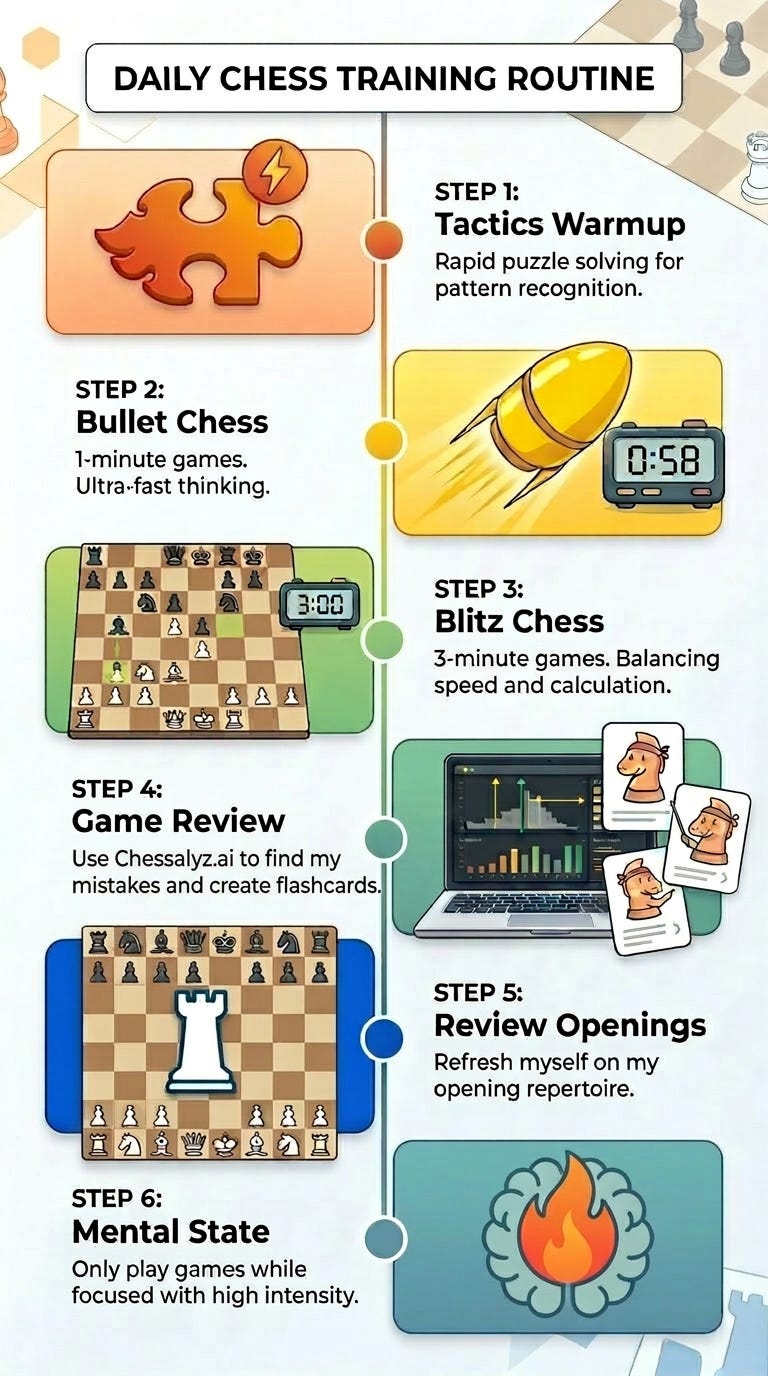
Notice that last part: I’m only playing games when I’m focused with high intensity. Your online chess games can absolutely be “real chess” if you bring real intensity to them. This article is about how to actually do that.
The Difference Between Showing Up and Being Locked In
There’s a concept in competitive gaming that I think applies perfectly to chess: the idea that tilt and poor performance are often less about skill and more about intensity and focus going into each game. In other words, the problem isn’t always that you don’t know what to do. The problem is that you aren’t giving yourself the best chance to actually do it.
Being locked in for an online chess game means a few specific things. It means closing the other tabs on your computer. It means putting your phone face down or in another room. It means sitting up straight in your chair instead of slouching on your couch. It means going into the game ready to give your best, not just passively clicking through moves while your mind is somewhere else.
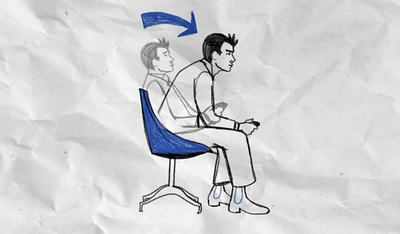
These might sound like small things, but they add up quickly. Physical cues like posture and environment act as mental signals (almost like Pavlov’s dog) that tell your brain it’s time to focus. When I’m in performance mode during my blitz quest, I put music on in my headphones, sit up straight, and set a specific number of games I’m going to play before I start. I rarely exceed that number. And I make sure I analyze each game using Chessalyz.ai either right after I play it or at the end of the session. It pulls out the critical moments and the flashcard feature lets me drill those positions later, so nothing slips through the cracks.
That routine is what separates a productive blitz session from mindlessly spamming games.
Learning Mode vs. Performance Mode
Not every online game needs to feel like a tournament game, but every game should have a purpose. I think about online play in two modes: learning mode and performance mode.
Performance mode is when you’re looking to play your best chess. Maybe you’re playing in an online tournament, or maybe you’re seriously trying to push your rating. In performance mode, you’re not experimenting or practicing new things. You’re trying to show the best version of yourself with what you already know. You should treat these games like real chess, with the same focus and intensity you would bring to an over-the-board game.
Learning mode is when you’re using your games as a training tool. You go into the game with a specific learning objective. Maybe you’re trying out a new opening you’ve been studying. Maybe you’re focusing on a specific part of your thinking process, like making sure you look for all of your opponent’s captures before committing to a move. Maybe you’re working on time management and your goal is simply to play faster and trust your moves more. Maybe you’re focusing on developing all of your pieces before launching an attack. The key is that you have a goal going into the game beyond just “win.”
Learning mode games can be taken a little less seriously in terms of rating pressure, because the whole point is to stretch yourself and try new things. But you should still be trying hard. The game is the laboratory where you test what you’ve been working on in your training time, and you don’t learn anything useful from a game where you weren’t really paying attention.
If you don’t play over-the-board tournaments at all and online chess is your main competitive outlet, then I’d encourage you to treat a lot of your online games as performance mode. Those games are your “real chess” and they deserve the same respect.
The Cost of Playing Without a Plan
I had a student once who genuinely believed (and I mostly agreed with him) that he was a stronger player than his rating showed. On his good days, he could play some really impressive chess. The problem was his bad days. He would play a bunch of games, lose a couple, get frustrated, and then keep playing more games to try to win the points back. He’d fall into a tilt streak and before he knew it he had dropped 100 or more rating points in a single sitting. Then the next week he’d climb back up, only to repeat the cycle all over again.
His ceiling was decent. But his floor was really, really low, and your rating is a reflection of how you play overall, not only on your best days. It’s like a basketball team that can occasionally beat anyone but also loses games they have no business losing. That team isn’t as good as their best wins suggest.
What this student needed wasn’t more chess knowledge. He needed a routine. He needed to go into each session with a set number of games he was going to play and actually stick to it. He needed a rule for himself: if he lost two or three games in a row, he would stop, take a break, and come back later (or not come back at all that day). He needed to analyze his games after each session instead of immediately queuing up the next one. If he had just avoided the massive drops, his rating would have climbed steadily over time because his good days were already good enough.
I coach students through this kind of thing all the time. The cycle of climbing, losing focus, and bleeding points is incredibly common and it almost always comes down to playing without a plan or continuing to play when your intensity has dropped.
A Pre-Game Checklist for Online Chess
One practical thing you can do starting today is use a simple pre-game checklist before you sit down to play. You don’t need to turn it into a whole ritual, but taking 30 seconds to run through a few questions can make a real difference in how focused you are and how much you get out of each game.
Here’s what I’d suggest:
- What mode am I in right now? Am I playing to perform, or am I playing to learn? Know which one before you start.
- What’s my goal for this session? If you’re in learning mode, pick a specific thing to focus on (a new opening, a part of your thinking process, time management, etc.). If you’re in performance mode, your goal is to play your best chess.
- How many games am I going to play? Set a number and stick to it. This is probably the single most important thing you can do to avoid tilt spirals.
- Is my environment set up for focus? Close unnecessary tabs. Put your phone away. Sit up straight. If you’re playing on your phone, make sure you’re not doing it while walking around or distracted by other things.
- What’s my stop rule? Decide in advance at what point you’ll walk away. Maybe it’s after a certain number of losses in a row, maybe it’s after you’ve played your set number of games, maybe it’s if you notice yourself getting frustrated. Have the rule before you need it.
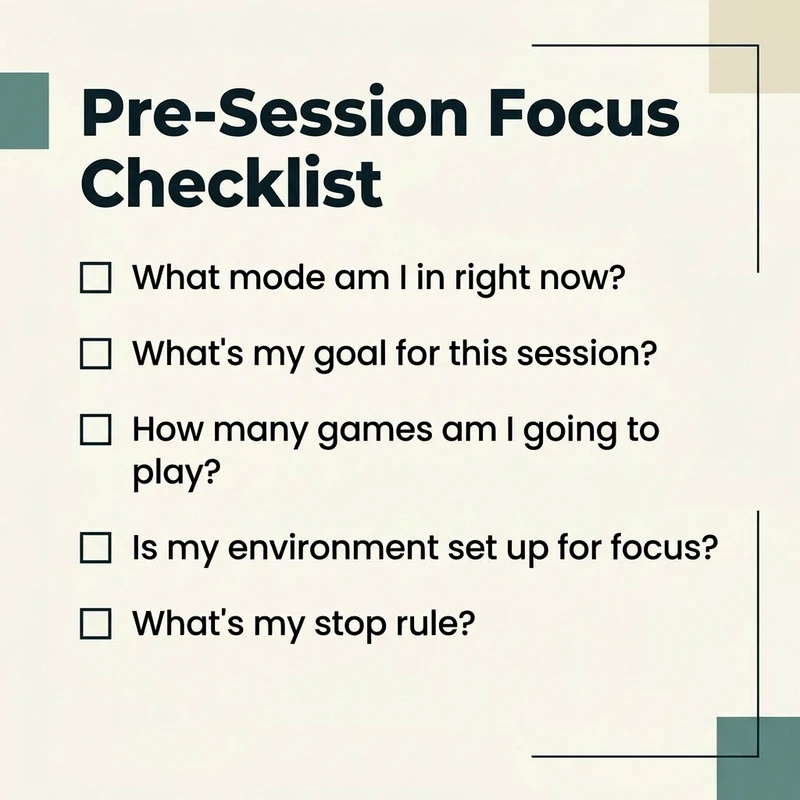
This kind of routine might feel unnecessary, but the players who improve the fastest are almost always the ones who are intentional about how they approach their games. Talent matters, knowledge matters, but intensity and consistency are what actually turn all of that into results.
Play Like It Counts
Online chess is as serious as you make it. You can treat it like background noise while you multitask, or you can treat it like a genuine opportunity to improve and compete. The games themselves don’t change. What changes is the attitude you bring to them.
Try the pre-game checklist before your next session. Set your game limit, pick your mode, identify your goal, and lock in. I think you’ll be surprised at how much more you get out of your games when you go into them with a plan instead of just clicking “New Game” and hoping for the best.
Let me know how it goes. I’d love to hear what changes for you once you start playing with more intention.
If you found this article helpful, consider checking out my Substack newsletter "Chess Chatter".
You may also like
 FM MattyDPerrine
Stop Gatekeeping Opening Study
Why chess players of every rating level should study openings, and what to focus on at each stage FM MattyDPerrine
Your Chess Training Plan Should Be Boring
Why the best training plans aren't exciting, and why that's a good thing. GM Avetik_ChessMood
10 Things to Give Up to Enjoy Chess Fully
Discover how embracing a lighter mindset can help you enjoy chess again and achieve better results. thibault
How I started building Lichess
I get this question sometimes. How did you decide to make a chess server? The truth is, I didn't. CM HGabor
How titled players lie to you
This post is a word of warning for the average club player. As the chess world is becoming increasin… FM MattyDPerrine