
Queen vs Three Pieces: The Wildest Imbalance I’ve Ever Seen
GM aspiringstar gives up the queen, reaches a bizarre three-pieces imbalance, and completely outplays White in the chaos.
Some games are memorable because of a single tactical shot. Others stay with you because the position itself becomes something you almost never see over the board.
This one belongs firmly in the second category.
What begins as a fairly standard Maróczy Bind structure slowly mutates into one of the rarest practical imbalances in chess: a queen against three pieces. And what makes it even more fascinating is that Black’s compensation is not immediately obvious in human terms. Materially, White looks better. Practically, the story is far more complicated.
Our favorite chess grandmaster aspiringstar once again shows why dynamic play and practical decision-making can outweigh raw material count.
A Typical Maróczy... Until It Isn’t
1. c4 c5 2. e4 Nc6 3. Ne2 g6 4. d4 cxd4 5. Nxd4 Bg7 6. Be3 d6 7. Nc3 Nh6 8. Be2 O-O 9. Qd2 Ng4 10. Bxg4 Bxg4 11. f3 Bd7 12. O-O a6 13. Rfc1 e6 14. Rab1 Qe7
I skipped over the first 14 moves as they were not as relevant. We begin in a familiar Maróczy Bind arising through the English.
White’s pawn structure with c4 + e4 gives excellent central control and usually leads to comfortable play. The strategic themes are classic:
- White enjoys space
- Black searches for freeing breaks
- pressure often revolves around d5, b5, and the c-file
Up to this point White has done everything quite naturally.
Then comes the first serious strategic mistake.
The Move That Started the Collapse
15. b4?
This is quite a radical decision by White.
At first glance it looks active, but strategically it is deeply out of tune with the position.
The key issue is simple: c4 becomes chronically weak.
Once the b-pawn advances, White permanently loses the option of defending c4 with b3.
That matters enormously in Maróczy structures.
Black immediately exploits the weakness.
15...Ne5 16. Nce2 Rfc8
This is textbook exploitation.
Black piles pressure onto c4 and White is already drifting toward a forced concession.
A very thematic alternative was 16...b5! with the idea of Nc4, an incredibly powerful outpost.
That knight would hit multiple targets while also opening the queenside where Black’s bishop pair becomes much stronger.
Instead, White is forced into exactly the kind of pawn break they generally want to avoid.
17. c5
This is essentially forced.
And strategically, this is where White’s pleasant bind begins to unravel.
The First Tactical Twist
17...dxc5 18. bxc5 Rxc5 19. Rxc5 Qxc5
Black chooses to liquidate quickly, even though there was no need for it, and simply defending b7 with Be8 was just enough.
Then White finds the tactical point.
20. Nxe6!
A very nice shot.
The knight grabs the pawn because the bishop on e3 suddenly attacks the queen.
For a moment it feels like White has turned the tables.
Black’s idea was likely based on activity after ...Qa3 and possible ...Nc4 tricks.
20...Qa3 21. Rb3!
This is a really strong practical move.
It completely cuts across Black’s intended ideas with Nc4 and now forces a major decision.
Black can retreat and suffer...
or complicate everything.
Naturally, aspiringstar chooses chaos.
The Queen Sacrifice
21...Qxb3! 22. axb3 Bxe6
This is the turning point of the game.
Black gives up the queen.
At first glance it looks insane.
But the practical point is clear:
- Black gets rook + bishop immediately
- active bishops
- open lines
- practical attacking chances
Still, objectively White should remain better.
Then comes the real bombshell.
The Stunning Resource
23. Nd4 Rd8 24. Qb4?
This retreat looks natural.
But it walks into one of the most beautiful tactical ideas in the game. A better retreat would've been Qc2.
24...Rxd4!
This move is absolutely brilliant.
That rook is under the attack of two pieces here, yet Black simply throws it in.
The point is deeply tactical.
If White captures with the queen, Black gets discovered tactics with ...Nxf3+, where Black would actually be winning all of the sudden.
If White captures with the bishop:
25. Bxd4 Nc6!
Now comes the fork.
Suddenly Black is winning back yet another piece.
This sequence is the true artistic heart of the game.
After
26. Qxb7 Nxd4
we reach the extraordinary imbalance:
Queen + 4 pawns
vs
Two bishops + knight + 3 pawns
This is one of those positions you almost never see.
Who Would You Prefer?
Objectively, engines may still slightly prefer White.
Practically?
I honestly prefer Black.
Three coordinated pieces, especially two bishops and a knight, can be far easier to handle than a lone queen.
The queen side often suffers from:
- lack of stable targets
- difficulty finding constructive plans
- constant tactical threats
- knight forks everywhere
Meanwhile Black’s moves almost play themselves:
- improve the bishops
- centralize the knight
- advance the h-pawn
- create pressure on the king
This is where human chess differs from engine chess.
A queen can be stronger materially.
But three well-coordinated pieces can be far easier to play.
White Loses the Thread
27. b4 Bf8 28. Qxa6 Bxb4 29. Qb6 Nc2
From here, White starts drifting.
The queen keeps moving, but without a coherent plan.
This is one of the hardest practical problems in chess:
what exactly should the queen be doing?
Attack?
Defend?
Harass pieces?
Force perpetuals?
It is not obvious.
Meanwhile Black’s coordination keeps improving.
31...h5
This is such a strong practical move.
The h-pawn becomes the long-term winning mechanism.
Rather than forcing matters immediately, Black slowly improves.
That patience is what makes the conversion so impressive.
The Fatal Impulsiveness
34. f4?
This move captures the psychological theme of the game perfectly.
White had been passive for many moves.
Then suddenly they lash out.
But it comes at exactly the wrong moment.
The move drastically weakens e4 and gives Black’s knight a stable route.
34...Nd6
Now Black’s pieces are fully stabilized.
At this point the queen no longer feels dominant at all.
In fact, White’s position begins to feel harder to play.
The Pieces Take Over
38...h4 39...Kf8 40...Kg8 41...Bd7 42...Bc6
This phase is a pure masterpiece.
Black doesn’t rush.
They improve piece after piece.
The bishops begin controlling huge diagonals.
The knight keeps jumping into strong squares.
The h-pawn keeps creating psychological pressure.
This is exactly why three pieces can outperform a queen.
The plans are clear.
The queen’s plans are not.
The Collapse
46...h3!
Now everything starts crashing down.
White is forced into concessions.
48. gxh3 Ne3!
Suddenly the knight invades.
Then comes:
49...Nd5
50...Bd8
52...Bb6+
53...Ne3
Now all three pieces have completely penetrated White’s camp.
This is White’s nightmare fully realized.
The queen has no stable checks, no perpetual, no active targets.
Meanwhile Black’s pieces coordinate flawlessly.
The final move is beautiful.
54...Ng4+
And White resigned.
A discovered check that ends everything.
A fitting finish to one of the strangest imbalances you’ll probably ever see.
Final Thoughts
This game is a brilliant example of something engines often struggle to teach humans:
practical coordination matters.
A queen is not automatically superior to three pieces in a human game.
If the pieces are coordinated and the queen lacks clear targets, the side with the pieces can often be easier (and sometimes stronger) to play.
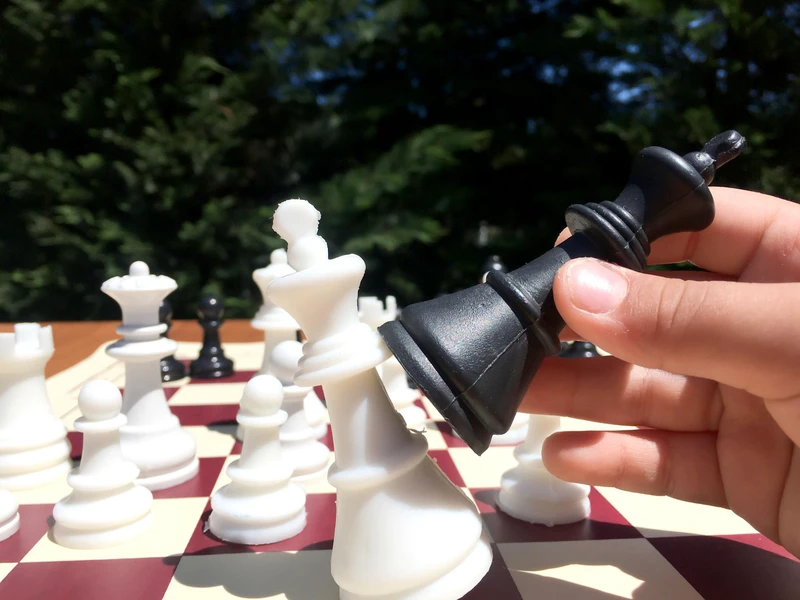
This game from aspiringstar is a perfect example that chess is not just about counting material.
Sometimes the strangest positions produce the most beautiful lessons.
You may also like
 FM MathiCasa
Chess Football: A Fun and Creative Variant
Where chess pieces become "players" and the traditional chessboard turns into a soccer field IM Lizard1
The Queen Sack Nobody Saw Coming
A strategically dubious bullet game somehow produces a genuinely beautiful queen sacrifice and matin… GM Avetik_ChessMood
10 Things to Give Up to Enjoy Chess Fully
Discover how embracing a lighter mindset can help you enjoy chess again and achieve better results. thibault
How I started building Lichess
I get this question sometimes. How did you decide to make a chess server? The truth is, I didn't. IM datajunkie
You’re studying chess openings the wrong way (do this instead)
If memorising opening lines made you stronger, many club players would be masters. ChessMonitor_Stats