
A Visual Recap of Norway Chess 2026
Summarizing the open section in 9 graphsAs every year, Norway Chess included a lot of top players, both in the open section and the women’s section.
In this post, I want to illustrate what happened in the tournament using some graphs.
I couldn‘t include the graphs for the women‘s section, so if you‘re interested in them, you can check out this post on Substack.
Open section
Scores
As usual, the scoring system in Norway Chess was a mixture of classical and armageddon games. A win in classical awarded 3 points, and a draw gave each player 1 point and lead to an armageddon game, where the winner got an additional half point.
The time control was also a bit unusual, with 120 minutes for the first 40 moves and after that only a 10 second increment, which meant that many games eventually turned into rapid games.
It’s always interesting to see how the players scored in the different formats.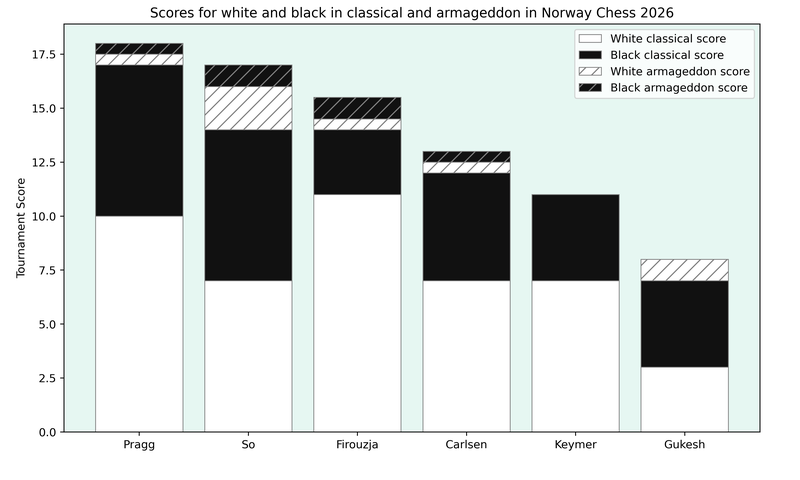
Pragganandhaa won the tournament, winning almost all his points in the classical portion. But he also won both armageddon games he was involved it.
Wesley So was the player with the most points in armageddon, and this is partly due to the fact that he had the least number of decisive games.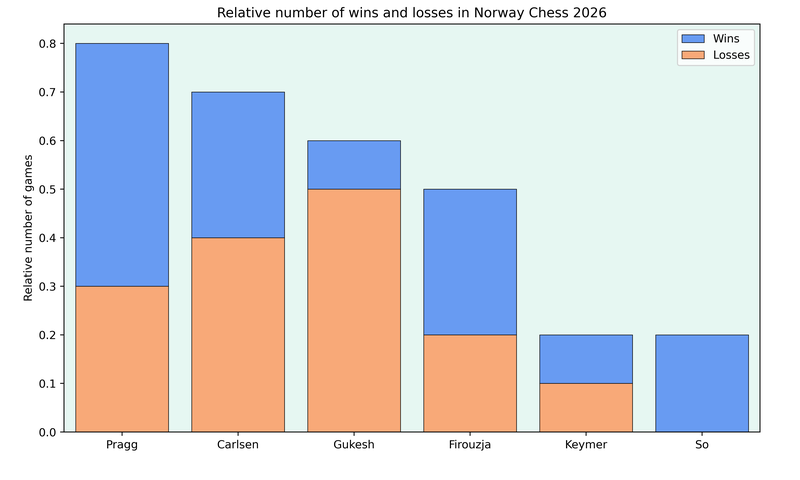
Both So and Keymer had only 2 decisive games, which means that they played 8 armageddon games. But whereas So made good use of the opportunities to score additional points, Keymer failed to win a single armageddon game.
It‘s also a bit surprising that Keymer had so few decisive games, as he was the player with the most decisive games in Wijk ann Zee and GCT Romania this year.
Better and worse games
I always like looking at the number of moves where the players stood better or worse, to get some indication of how their games went.
Below, a much better positions means an evaluation of more than +1, while better positions have an evaluation between +0.5 and +1 and equal positions are between -0.5 and +0.5.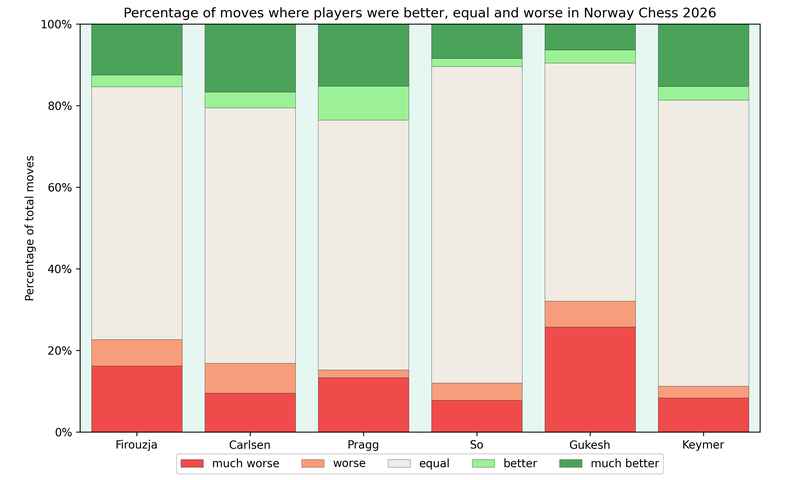
Overall, the number of non-equal positions was quite high in this tournament. One part of the reason could be the time control, as players may play on longer in lost positions when there is only a 10 second increment at the end of the game.
This graph shows that Gukesh had a really rough tournament, whereas Carlsen‘s bar looks similar to Pragg‘s. This shows that Carlsen often made big mistakes late in the game, which lead to some of his losses but didn‘t increase the number of bad positions too much.
Of course, standing better is only useful when players convert these games into full points (or in this case into 3 points).
Below you can see the number of games where the players reached a better position compared to the number of wins.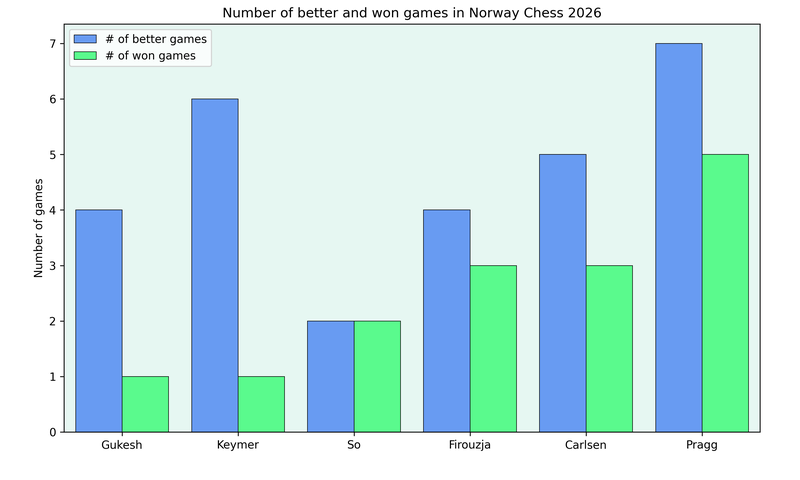
So was very efficient in this tournament, while most other players failed to convert at least 2 of their games with advantages into wins.
Keymer especially struggled with conversion, he was better in 6 games, but only managed to get 1 win from them.
We can also look at the number of games where players stood worse compared to the number of their losses.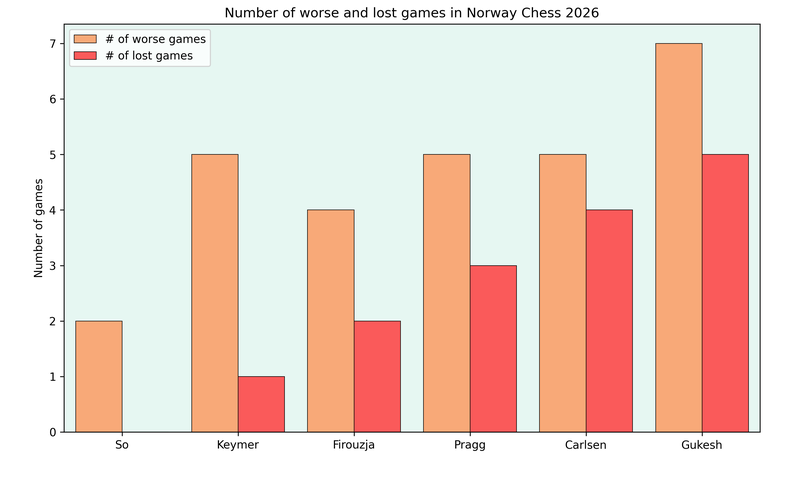
Since there were many missed chances, there were also many bad games that got saved.
All players apart from Carlsen managed to save at least 2 bad games and the difference between him and Keymer is stark, as both stood worse in 5 of their games, but the German only lost 1 of them.
Engine evaluation
Finally, I also want to take a look at what the engine has to say about the games in the tournament.
Firstly, let‘s look at the number of inaccuracies, mistakes and blunders by each player.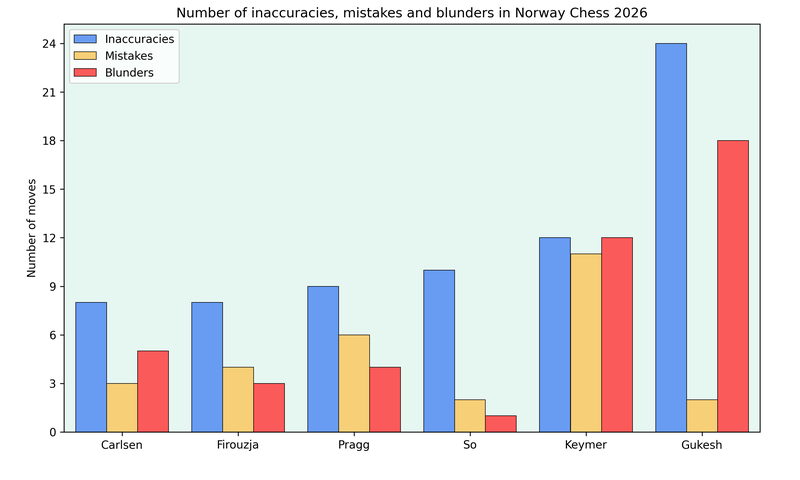
Again, it‘s clear that Gukesh wasn‘t having a good tournament and the same can be said about Keymer.
Carlsen‘s numbers are once again interesting, as he didn‘t commit too many mistakes and blunders, but lost 4 games. This is a combination of making singular big mistakes that end the game and not having too many advantages that he didn‘t convert.
We can also look at the average game accuracy for each player. As the accuracy by itself isn‘t too meaningful, I always like to compare it to the accuracy of the opponents to see the difference.
Note that I use my own accuracy function based on grandmaster games, so the numbers are lower than on Lichess. It‘s still a scale of 0-100, and in this case an accuracy of x means „more accurate than x% of classical GM games“.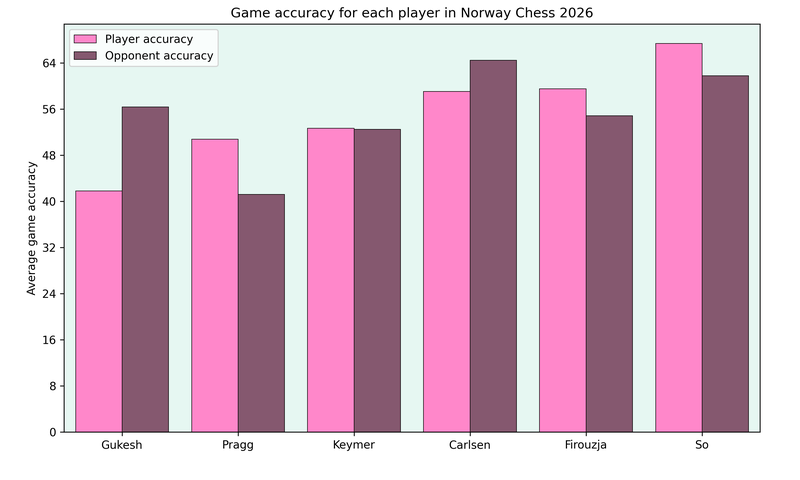
Given that So was hardly ever in trouble and managed to convert all his advantages into wins, it‘s hardly surprising that he was the most accurate player.
But looking at the difference between the accuracy of a player and their opponents is more insightful than just looking at the accuracy itself.
Pragg‘s accuracy is the second lowest, but his opponents in his games had the lowest accuracy. This indicates that the games were complicated and difficult to handle, but Pragg managed it much better than his opponents.
Overall, the game accuracies are very low, especially compared to the Candidates tournament.
I guess that this is partly due to the time control, the players got 120 minutes for the first 40 moves and then only a 10 second increment. So, the players were effectively playing rapid chess if the games went on too long.
To see how the time control impacted the quality of play, I looked at the expected score loss per move in different game phases.
The expected score loss per move shows how much the players lowered their expected score, which is based on the engine evaluation, per move. For example, an expected score loss of 2 would mean that players reduce their expected score by 2% with each move they make.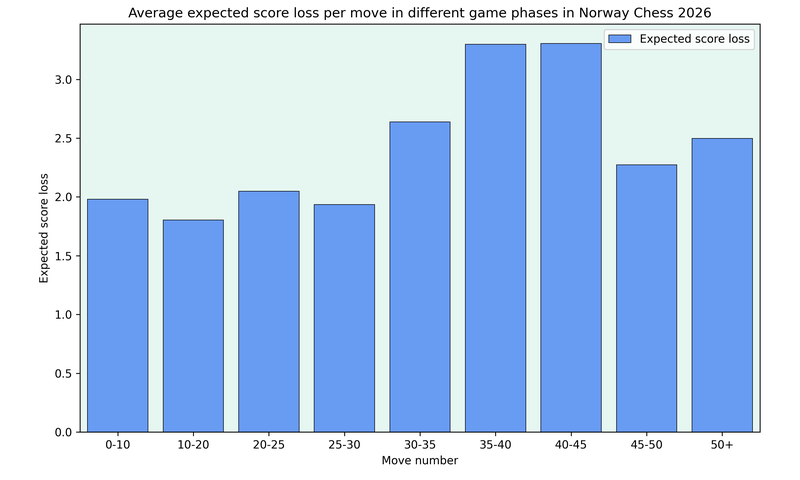
I decided to use the move number instead of the time remaining, as this also shows where the increment start.
After move 30, the accuracy of the players started to drop off quite a bit and stabilized slightly with the increment.
We can also look at the median time (dis)-advantage each player had after every move.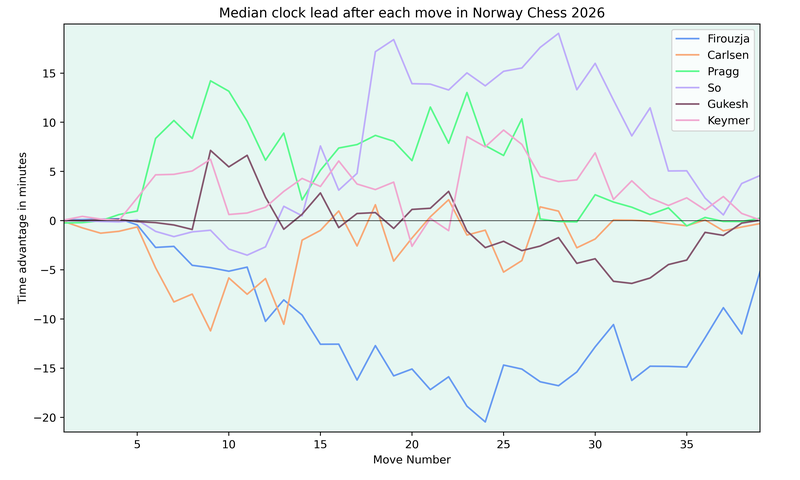
This plot shows that Carlsen spent a lot of time in the opening, he basically had a small time disadvantage right from the start, which grew to about 10 minutes by move 7.
Firouzja was generally playing much slower than his opponents, while Pragg got a time advantage early on, which already worked very well for Sindarov in the Candidates.
I wasn‘t able to include the graphs for the women‘s section, so if you‘re interested in them, check out this post on Substack.
You may also like
 CM HGabor
How titled players lie to you
This post is a word of warning for the average club player. As the chess world is becoming increasin… jk_182
Do Attacking Players play more Forcing Moves?
Finding forcing moves and looking through the games of world champions jk_182
Quantifying Piece Activity
A second attempt to calculate the activity of a chess position jk_182
How have White's Responses to the Najdorf Changed over the Years?
Looking at popularity of white's 6th moves in the Najdorf variation jk_182
How Opening Advantages Translate into Results in Online Games
Measuring conversion rates in online blitz and bullet games for 1200 to 2400 rated players jk_182