
FIDE
Interview with GM Felix Blohberger alias febloh

Interview questions by David Moreno Rivilla
1) Hello Felix, thank you very much for taking the time for this interview! You've been a Grandmaster since 2022 and have some impressive achievements to your name — for instance, you won the U16 EY-Open in Riga in 2018, and in 2022 you became Austrian Champion. Which achievement do you look back on most fondly?
You're very welcome! At the Classical U16 European Championship in 2018 I finished fourth, but it was still a great result. If I remember correctly, I was only a handful of Buchholz points short of bronze...
My titles at the Austrian Championships — especially the Classical title, of course — naturally mean a great deal to me. Beyond that, my win at the St. Louis Spring B tournament really stands out.
2) You recently said in an interview that your goal is to reach 2600 Elo. You're currently at 2543 and you're 23 years young — certainly an achievable goal. Have you mapped out a plan to get to 2600? What do you want to work on in the coming months?
At 23, I honestly don't feel that young anymore 🙂 The competition in chess keeps getting younger and stronger! It's not easy to juggle everything I'm currently doing. When I'm at home, I dedicate most of my time to my YouTube channel, my students, and the courses I'm working on. I take a lot of inspiration from Sam Shankland — whenever he prepares something for his students or his courses, he always tries to benefit from it himself as well.
3) At the World Cup in Goa you played really well against GM Yu Yangyi in round two and only narrowly lost in the tiebreaks. How do you mentally approach such games against players from the world elite?
What was nice about the World Cup for me was that I had nothing to lose. Even in the first round I was the underdog, and against Yu Yangyi I just wanted to play my best chess and enjoy the experience. A nice thing for me is that playing chess isn't my main source of income, so I don't depend on the prize money and can approach big tournaments relatively relaxed.
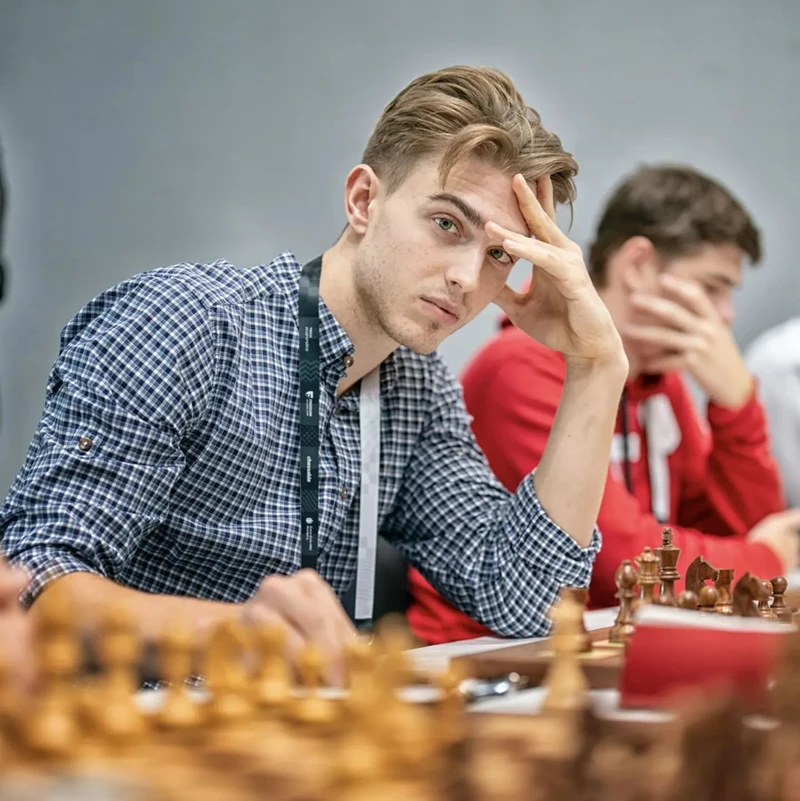
 Felix also participated at the FIDE World Cup 2025 (Photo: FIDE)
4) You're also very active on your YouTube channel and often stream your games. What motivates you to share insights into your chess life, and how important is the channel to you personally?
I started with YouTube for several reasons. On the one hand, I'm glad that many people enjoy watching my analyses and can benefit from them; on the other hand, it's good for my personal brand. You get many more inquiries for private coaching, courses, and other opportunities like commentary work. Above all, I'm happiest about my lovely community, who watch my "recaps" regardless of whether I played well or badly 🙂
5) A year ago you published a fairly viral video on your channel explaining why it's difficult to be a chess professional in Europe, especially financially. At the time of this interview (early February), you're in Ireland to play in the Sligo Chess Festival. Has your situation improved since that video?
Definitely. As it happens, I recently made a follow-up video to also highlight the positive aspects of life as a chess professional. That one didn't quite go as viral, of course. Over time I've also reflected a lot and changed my mind on some things. For example, last year I said I found it "unfair" that chess players don't earn much money. Pay is "unfair" in plenty of professions, and many of those jobs are more important than chess... I think the most important realization for me was that when you work in a niche like chess, things aren't simply handed to you just because you're a Grandmaster. You have to put in the hard work, and then more opportunities will come.
6) You started playing chess at the age of 5. What memories do you have from that time?
I learned chess in kindergarten — there was a project back then called "Chess at the After-School Club" (which was actually aimed at children already in school). I watched the older kids playing and was so fascinated that the coach made an exception for me. I don't remember many things from that age in general, but almost all my memories have something to do with chess. My parents told me that even back then I could hardly stop playing blitz with friends!
 Felix recently won the Sligo Chess & Culture Festival 2026 in Ireland.
7) What's the most unusual thing you've ever experienced at a chess event?
Lots of things come to mind, some of which aren't really suitable for a chess magazine. I always find it lovely to see that older people still enjoy playing chess. Right now, for example, I played a 79-year-old gentleman in the first round. It fascinates me that people at that age still love the game. It also shows that chess is unique as a sport — anyone can play it, regardless of age or other factors.
8) Do you handle losses in chess well?
These days, yes. As a child I often cried after losses, of course. Once I even destroyed my straw hat after a game 😂. I think it's normal to still get emotional after disappointing games even as an adult, especially when you're pursuing goals. For me it was always important to treat my opponent respectfully, even after disappointing results. Lately it's become even easier for me to deal with chess disappointments. Partly I'm used to it by now, and partly, playing chess isn't the only thing I do in life.
9) How does youth development in Austria currently look overall? What needs to be done so that more children — and especially more girls — play chess?
In Austria, a great deal has happened in the last 10 years when it comes to youth development. You can see that in our national team too. Alongside me, two very strong Grandmasters have emerged in Austria: Valentin Dragnev and Dominik Horvath. This is thanks to various youth chess initiatives. And things look good today as well. The 15-year-olds Lukas Dotzer and Peter Balint are now providing serious competition for my generation. Dotzer needs just one more GM norm for the title. There are also several initiatives in girls' chess, and I hope that Austria will soon have a successor to the world-class player Eva Moser, who passed away far too early.
10) How well can you apply your chess skills in everyday life? Are you, for example, more patient than others, or do you stand out with good time management?
Chess has already taught me a lot for life — that's beyond question. You learn how to handle losses and how to concentrate for long stretches. The latter is especially important nowadays in our fast-paced world.
11) Which chess players are your role models, and why?
I more or less grew up with Magnus Carlsen as world number one, and so he's my favorite player. It's incredible how long he's already been playing at that level — even now, after becoming a father and having many sleepless nights! I always enjoy watching him play. Who knows how much longer he'll keep going...
12) What would you recommend to our readers who want to improve in the following areas?
Opening:
My opening courses and YouTube videos 🙂 Generally, it's incredibly important for the average tournament player not to focus solely on forcing opening lines, but rather to have a solid grasp of the middlegame plans and the various tactical ideas. That gets neglected far too often nowadays, and it's something I always place great emphasis on. I find it more practical to play simpler lines so that more time is left for other things. You can't really get an opening advantage nowadays anyway... I also offer a monthly subscription on my YouTube channel where you get a new mini-repertoire each month. Something else that helps me a lot is keeping up with current tournaments to stay up to date.
Middlegame:
Books, books, books! I'm still convinced that reading, playing through, and visualizing annotated games is the most useful thing you can do. Another positive aspect of training with books is that you can't just fire up the engine when you're too lazy to solve a position yourself. Artur Yusupov's Tigersprung series personally helped me a great deal, and I think the material it presents is still extremely relevant today.
Endgame:
I almost always train endgames with books as well. Recently I picked up Sam Shankland's book Theoretical Rook Endgames and can highly recommend it to any ambitious player.
13) What interests do you have apart from chess?
I enjoy going to the gym and following current topics like geopolitics and economics. I always find it fun to learn new things. I often read books on all sorts of subjects or watch YouTube videos.
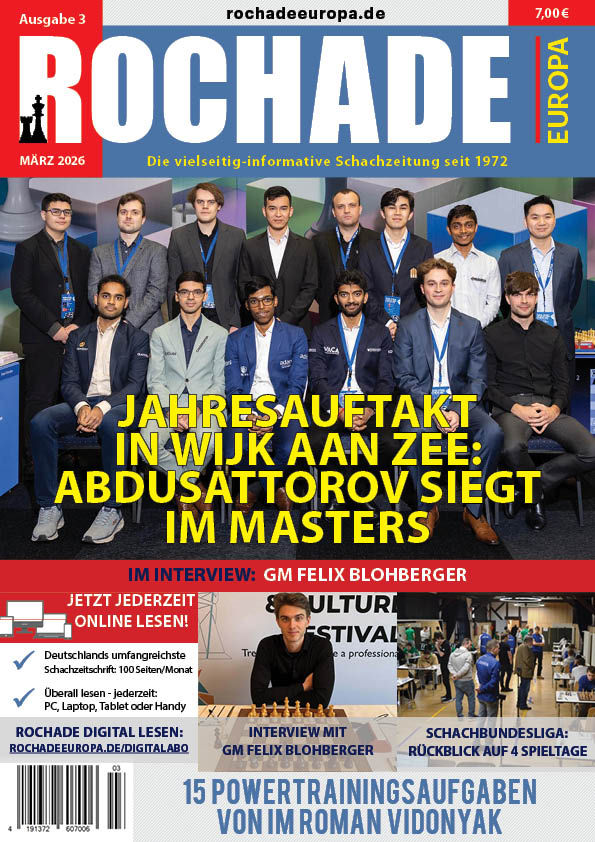 Note that this article was first published originally in German in the March 2026 issue of the German chess magazine Rochade Europa).
You may also like
 CM HGabor
How titled players lie to you
This post is a word of warning for the average club player. As the chess world is becoming increasin… FM jeffforever
Interview with IM Lu Miaoyi & WGM Xu Yuanyuan
Get to know the Chinese prodigy IM Lu Miaoyi who won the Women's Tournament of the Sparkassen Chess … FM jeffforever
Interview with GM Christopher Noe alias gravereaper - Lichess streamer & coach
Get to know the 29-year-old GM, who likes to play in strong tournaments on a regular basis FM jeffforever
Interview with GM Zahar Efimenko - New German Women's Team Coach
Get to know the New German Women's Team Coach (Peak Elo: 2708 in March 2011) thibault
How I started building Lichess
I get this question sometimes. How did you decide to make a chess server? The truth is, I didn't. ChessMonitor_Stats