
Credit: РЕГИНЫ ЛЕМБЕРГ Source: Moscow tournament bulletin, 64, High Quality Copy provided by Philippe Pierlot to Chess Historian Edward Winter
Did the Soviets Collude Against Capablanca?
I Investigate The Claims By Looking At The Evidence
José Raúl Capablanca became World Champion in 1921 and reigned till 1927, when he was defeated by Alexander Alekhine. In the early 30's Capablanca retired from chess but then he came back and had a resurgence in the mid 30's.
Mikhail Botvinnik was the great product of the Soviet chess school and was the top Soviet player during the 30's. He eventually became World Champion in 1948 in the round robin tournament held after Alekhine's death and reigned till 1963.
Alexander Ilyin-Genevsky was a chess master and commissar in the Russian military. He created a number of tournaments to develop Russian chess such as the All-Russian Olympiad in 1920, which morphed into the USSR Championship. There was always a chess culture, and some Russian masters reached the elite level such as Mikhail Chigorin who played in two world championships. But the 1920's was the start of the rapid development of professional chess in Russia, resulting in the nation dominating top level chess completely.
The famous International Moscow Tournament was held 1925. The tournament was organized by Nikolai Krylenko, who was a Supreme Commander of the Red Army and later became People’s Commissar for Justice and the head of the Chess and Checkers Section. He was the most influential figure in the early development of Soviet Chess.
Krylenko created the tournament to allow the Soviets to test their strength against the best foreign players. Krylenko was fond of chess and he wanted to make the Soviet Union a force as their players had not been prominent in international chess up to this point.
Krylenko was a important supporter of Botvinnik and arranged matches and tournaments for him while sorting out the political nuances of getting permission to go abroad. One important match was Botvinnik-Flohr in 1933. Salo Flohr was a Czechoslovakian master. After a tense battle with the score tied, Flohr proposed a draw for the last game in advance in recognition of their even contest.
Krylenko organized the 1935 Moscow tournament. Botvinnik and Capablanca both participated.
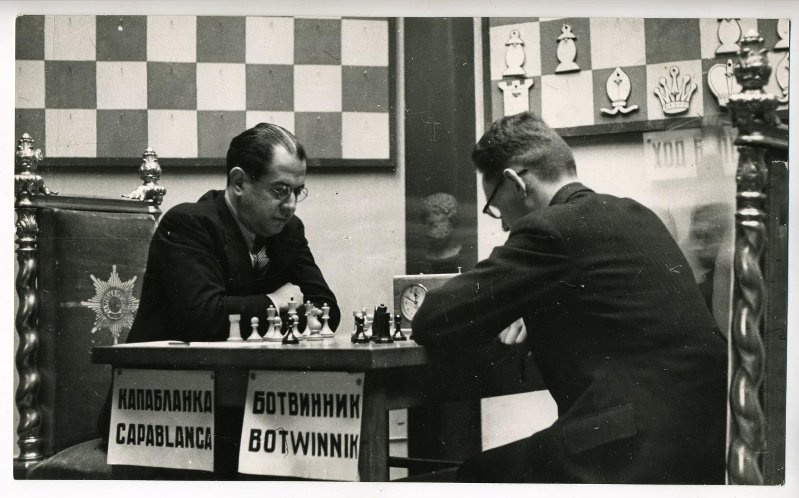 Capablanca vs Botvinnik, Round 2, 1935 Moscow. Source: zenonchessediciones.com via mann-mdf.ru
Botvinnik tied first with Flohr. Lasker came second and Capablanca third.
"The USSR, in the person of Mikhail Botvinnik, defeated bourgeois chess culture, as his only rival, finishing in first place with him, Flohr, did not actually win this first place, but received it as a kind of gift from the Soviet masters Kan and Bogatyrchuk, who beat Botvinnik and thus allowed Flohr to draw equal with his rival."
"True, bourgeois Europe may point to the fact that the runners-up were all foreigners: Lasker, Capablanca, Spielmann. But, in the first place, these were ex-world champions Lasker and Capablanca, and in the second place, Spielmann won his place in the very last rounds, while Levenfish was confidently catching up with him. We do not yet expect, by the way, that Soviet masters should occupy all of the top places, although, without unnecessary modesty, we have reason to think that such a moment will come in the not-too-distant future."
Nikolai Krylenko, 1935 Second Moscow International Tournament, Tournament Book Preface, Source: https://sovietchesssets.com
Botvinnik proposed to Krylenko that another edition of the tournament be created, saying that the mix of strength in the playing field made it less clear to see the strength of the Soviets compared to the foreign masters:
"At the beginning of 1936 I wrote a letter to Krylenko in which I analysed the results of the 1935 International Tournament and suggested a new tournament in Moscow. The essential point was that the 1935 tournament has included both strong grandmasters and comparatively weak masters. It was hard to judge the genuine strength of players on the results of such events. It would be a different state of affairs if only strong players took part and the event was repeated - a so-called match-tournament. I further proposed inviting five strong foreign masters to the new event and selecting the five best Soviet players, arguing that this would be a real test of our strength and good training."
"The players invited were Lasker, Capablanca, Flohr, Lilienthal and Eliskases, and from the Soviet side four young players (Botvinnik, Ragozin, Ryumin and Kan) as well as one from the older generation (Levenfish)."
Mikhail Botvinnik, Achieving The Aim, 1981, p.44
 Sitting L-R: Krylenko, Ryumin, Lasker, Capablanca, Levenfish. Standing: Botvinnik, Eliskases, Lilienthal, Kan, Flohr, Ragozin. Credit: РЕГИНЫ ЛЕМБЕРГ Source: Moscow tournament bulletin, 64, High Quality Copy provided by Philippe Pierlot to Chess Historian Edward Winter
Capablanca won the tournament with 13/18, defeating Botvinnik in one of their two individual encounters. Botvinnik came second with 12/18.
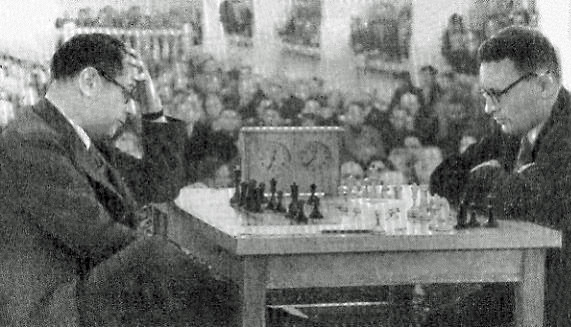 Botvinnik vs Capablanca, Round 7, 1936 Moscow. Source: sovietchesssets.com
Chess is filled to the brim with neat little anecdotes. These anecdotes are often amusing or feature grandiose claims.
One such anecdote is the famous story of how Capablanca told Stalin to stop the Soviet players from losing on purpose to Botvinnik.
Letter by Capablanca's wife: https://www.chesshistory.com/winter/extra/capablancaolga.html
"Our correspondent notes that Capablanca’s complaint to Stalin was referred to on page 212 of A Chess Omnibus. Olga Capablanca mentioned such an incident to us a number of times (in writing and orally), and below we reproduce verbatim what she wrote to us on 26 July 1989:"
‘It is little known, I believe, that Stalin came to see Capablanca play, hiding behind a drapery. This happened in Moscow in 1936. Capa had mentioned it to me en passant, so I am a bit hazy about the details, such as who had accompanied Stalin – seems to me it was Krylenko. However, the gist of this encounter remains quite clear in my mind.
Capa said to Stalin: “Your Soviet players are cheating, losing the games on purpose to my rival, Botvinnik, in order to increase his points on the score.”
According to Capa, Stalin took it good-naturedly. He smiled and promised to take care of the situation.
He did.
From then on the cheating had stopped and Capablanca had won the tournament all by himself. This was an important conquest, proving to the world that Capablanca returned to his own great form.
As he told it to me Capa added: “I had promised you to be again the best chessplayer in the world. So I have done it for you.”
The anecdote changed in later years from Soviets losing games deliberately to Soviets drawing games to save energy after chess master Allen Kaufman shared his remembrance of what Olga Capablanca had told him for a letter response to a 2007 New York Times Article.
‘Capa was playing in a tournament in Russia in the 1930s. Some of the best in the world’s best [sic] were competing, including Soviets and foreigners. A famous personality arrived to watch the event: Stalin.
The dictator approached Capablanca and asked, “How do you like my tournament?”
Capa replied, “It’s terrible; your players are cheating.”
Stalin: “What do you mean?”
Capa: “When they play against each other, the Soviets make quick draws and they get to rest. When they play against me, they fight on and on just to make me tired.”
The cheating stopped immediately.’
This later anecdote is a second hand source of a second hand source of Capablanca's alleged comments made decades later. The 2007 version is also more tame, merely alleging deliberate draws by the Soviets rather than the Soviets throwing games against Botvinnik.
Olga Capablanca had said that Capablanca accused Soviets of losing on purpose to Botvinnik (different to the common anecdote of Soviet drawing games to rest and put their energy into playing against Capa).
 Flohr vs Botvinnik, Round 6, 1936 Moscow. Source: sovietchesssets.com
In order to assess the reliability of the story we must look at the source.
The source is Olga Capablanca who was Capablanca's wife. She related another story about the 1939 Buenos Aires Olympiad match: https://www.chesshistory.com/winter/extra/capablancaolga.html
At one time, Capa, the head of the Cuban team, was due to play against Alekhine. And Capa won. [In fact, Capablanca did not play in the Cuba v France match.]
That day an amusing episode occurred. One of Capa’s most ebullient friends, Dr Querencio, challenged Alekhine to a duel if he continued to refuse Capablanca a revanche match. Harsh words followed. Alekhine cut them short by running out to the men’s room and locking himself in. Undaunted, Querencio waited for him at the door. I was told that Alekhine had stayed in that bathroom for nearly an hour, until friends of Dr Querencio convinced him to leave his post. Only then had Alekhine carefully emerged and run away. This episode created quite a few laughs in Buenos Aires. But Capa merely shrugged his shoulders.
In the August-September 1939 Buenos Aires Olympiad, Alekhine and Capablanca were due to play each other on their respective boards. However Capablanca skipped the round, having explained to the Argentine Chess Federation in advance that he would not be playing Alekhine:
"Last night’s match between France and Cuba was drawn two-all. I should like to explain my absence, which was due to purely personal reasons.
Neither France nor Cuba was a leading contender in this competition, which meant that from that point of view there was no special significance in whether or not I played. There was only the question of the spectacle itself, which of course could not influence the course of the tournament.
Once more it is necessary to emphasize that the event being held at the Politeama is a tournament for teams, not individuals. A week ago I notified the Argentine Chess Federation that I did not intend to play against Alekhine, and I explained my reasons for this decision.
I made this announcement to the Federation so that my intentions were known in advance, and to prevent disappointment on the part of the public. My not playing yesterday was thus not an act of discourtesy to the Federation, nor a lack of consideration for the Buenos Aires public.
Therefore there was no question, as has incorrectly been stated, of my refusing a favour asked by the Federation. I have, and have always had, the best intentions towards the chess public and the organizing body."
Capablanca, article in the Argentine newspaper Crítica, 15 September 1939, Edward Winter Chess Note 4696
Capablanca did not play Alekhine in the 1939 Olympiad and announced this in advance. However Olga Capablanca remembers Capablanca playing Alekhine at the Olympiad and defeating him. Followed by Alekhine locking himself in the bathroom to hide from Dr Querencio who was one of Capablanca's friends and arbiter of their 1927 Match. This makes the anecdote about Capablanca complaining to Stalin less reliable.
There is an interesting story about the previous edition 1935 tournament, where Botvinnik and Capablanca were both participating.
Flohr and Botvinnik were tied for first before the last round. During the last round, Krylenko asked Botvinnik about what he'd think about Rabinovich throwing the game to him.
"Finally we got to the last round. Flohr and I were level, I had to play Black against Rabinovich, Flohr had to play Alatortsev. There was a knock at my door and Krylenko came in. "What would you say," he asked, "if Rabinovich were to lose to you?"
"If I realize he is giving me the point then I will myself put a piece en prise and resign the game on the spot". Krylenko looked at me with obvious friendliness. ", Well what should be done?"
"I feel that Flohr himself will suggest that both games be drawn, after all he did something similar during our match." Then I gave a cunning laugh, "Moreover he might be frightened that Rabinovich will 'throw' the game." At that point Weinstein came in: Flohr was offering two draws. Krylenko beamed. Rabinovich gave us his assent, but Alatortsev jibbed at it. "Let him play," said Flohr "It will be a draw."
Play began. Despite Krylenko's ban on it I was the first to offer a draw. Flohr's task was more complicated, since Alatortsev had actually fallen into a difficult position, but the honourable Flohr made a draw.
Mikhail Botvinnik, Achieving The Aim, 1981, p.43
So Krylenko suggested to Botvinnik that his opponent throw the game to help him win the 1935 Moscow tournament. But Botvinnik refused. Flohr also offered a prearranged draw to Botvinnik. The foreign master had previously played a match against Botvinnik in 1933 and offered to draw the last game in recognition of their equal contest. This was back when attitudes were more relaxed in top level chess.
There was no collusion in the previous 1935 tournament. There is no evidence that the Soviets threw games. Krylenko proposed it to Botvinnik in the last round, and Botvinnik said no. Botvinnik was also beaten by the Soviet masters Kan and Bogatyrchuk in the tournament which is the opposite of collusion.
I haven't found any evidence of anyone else claiming that Soviets threw games during the later 1936 tournament. Olga Capablanca's story seems to be the only source that claims this.
In the 1936 tournament Capa got 13/18 and Botvinnik got 12/18.
Here is a graph of the running total score for Botvinnik and Capablanca:
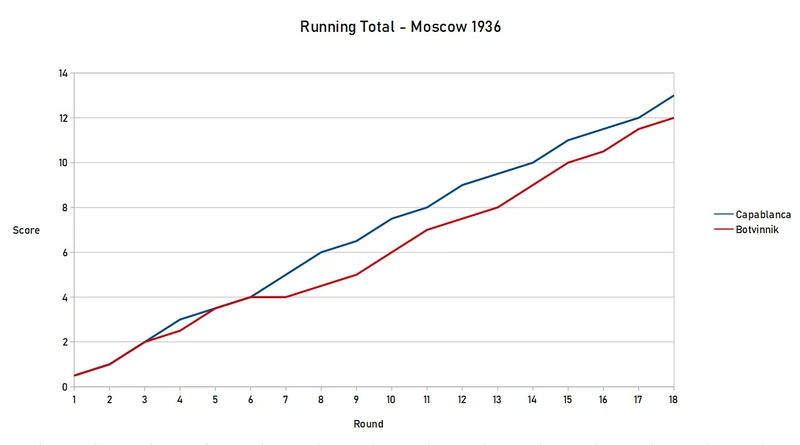
Botvinnik was never ahead of Capablanca in this tournament. So it seems odd that Capablanca would complain.
If Capablanca would complain, then clearly the start of the tournament would be the only logical point for this as Capablanca was clearly leading from Round 6 onwards. According to Olga Capablanca's story Capblanca said:, “Your Soviet players are cheating, losing the games on purpose to my rival, Botvinnik, in order to increase his points on the score.”
But in the first 6 Rounds, Botvinnik only beat one Soviet (Kan). Meanwhile Capablanca had beaten two Soviets (Ryumin and Ragozin). So claiming that the Soviets (plural) were throwing games to Botvinnik would be nonsensical. This casts doubt on the story.
The Capablanca anecdote is neat factoid that has been spread around. Most people aren't aware of the fact that the only source for this anecdote was Olga Capablanca. She also said that Capablanca defeated Alekhine at the 1939 Olympiad, but this never happened as Capablanca boycotted the match, presumably because he felt the Alekhine was trying to avoid playing a World Championship match with him. Olga Capablanca also claims that Alekhine locked himself in the bathroom for 'over an hour' after Capablanca's friend challenged him to a duel if he didn't accept Capablanca's challenge. This comedic story is hard to believe considering that Capablanca didn't actually play against Alekhine at the Olympiad.
The source for this anecdote is not reliable. There is nothing strange about the tournament. Botvinnik was never ahead of Capablanca in the standings, so it seems odd for Capablanca to complain. Botvinnik's tournament wins don't match the description of "Soviet players are cheating, losing the games".
I couldn't find any reference to Stalin visiting the tournament, which presumably would have been reported in the chess news. Botvinnik also doesn't mention Stalin showing up in his autobiography.
Conclusion: There is no evidence supporting the claim that the Soviets colluded against Capablanca in the 1936 Moscow Tournament.
You may also like
 Lichess
Lichess: End of Year Update 2025
Is it just us, or has this year flown by? As we say goodbye to 2025 and enter 2026, let's look back … RuyLopez1000
Fischer vs Larsen: The Rivalry
Explore one of the Greatest Rivalries in the History of Chess ChessMonitor_Stats
Where do Grandmasters play Chess? - Lichess vs. Chess.com
This is the first large-scale analysis of Grandmaster activity across Chess.com and Lichess from 200… RuyLopez1000
The Candidates Qualification System
Thoughts on the Candidates Qualification System RuyLopez1000
Bobby Fischer's GOATed Endgame
Bobby plays a brilliancy. Instructive Lesson. thibault