
Google Gemini, mostly
A New Platform for Variations and Game Design
I'm an amateur chess player and creator of a free tool that I think will help people implement creative ideas to make games that have never been played before.Hey everyone, for the last several months, I've been working on a passion project and website that allows users to design and create custom grid-based strategy games, pieces, and play those games with other users. I've noticed that on both Lichess and Chesscom, there are limited variant options that I felt left an opportunity for a better custom game design experience. It's called GridGrove and currently supports a huge number of variants, focusing mostly on chess functionality, but also other grid-based strategy games. From it, you can create and play entirely new games.
I wanted to use this post to explain a bit about what you can do on the site, how to do it, and to ask the community what they think or if it's something they're even interested in. Firstly, I'll cover piece customization options.
When creating pieces GridGrove allows you to:
- Upload images (up to 8) per piece. You can choose which images to use for your game during game setup.
- Name the piece/add descriptions
- Change pieces to be able to occupy more than 1 square (up to 4x4).
- Move in any direction, up to any number of squares ("exact" movement).
- Have special movement styles available for the first N moves only (like a pawn's movement the first time it moves).
- Ratio movements, like the knight. You can set the ratios to any value. You could make a piece that goes 3 squares, and then 5 perpendicular.
- "Step-by-step" movements, which allows pieces to move in any direction (like a king) up to N number of steps, while being able to change direction.
- Hopping ability (over allies and enemies). Also, options to require hopping for capture, or only allow hopping when using ratio/exact movements.
- Custom movement/attack square specification. You can literally just highlight squares on the board around a point that defines exactly how the piece moves. This is the most flexible option if you're not sure what the other options will do.
- Ability to capture in ALL of the above ways.
- Ranged capture options - like the ability to capture pieces N number of squares away without moving the piece. Can use ratio/directional ranged.
- Castling/Promotion functionality.
- Ability to capture allies
- Ability to create the piece anonymously (if you so choose, you can protect your privacy).
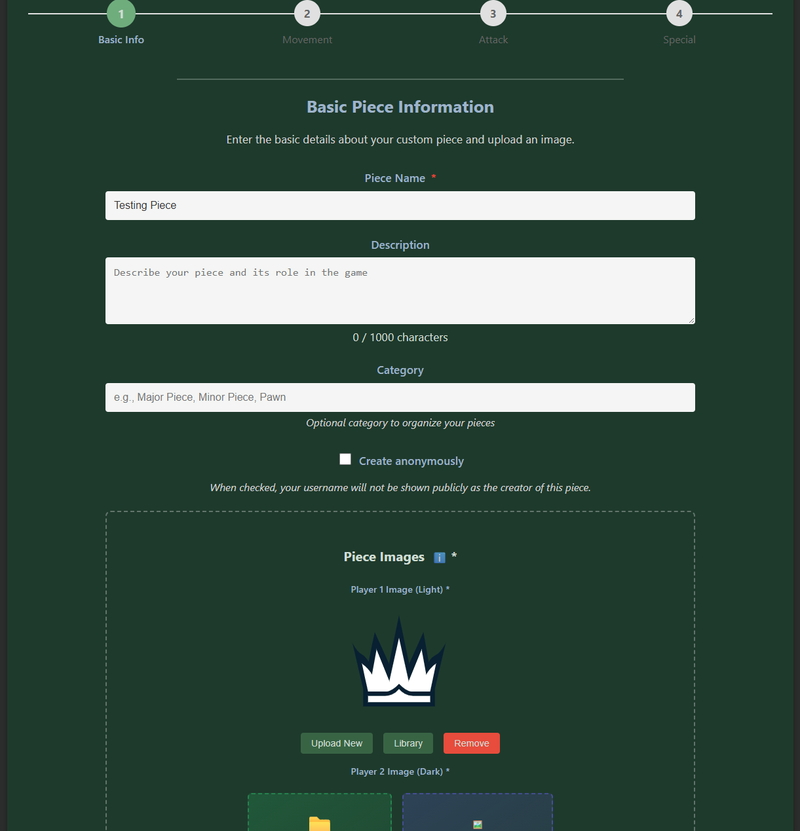
Beginning of the piece wizard above ^
These are not all the piece options - just the options that you can set from the create piece wizard. In the game wizard, you can customize created pieces to inherit new abilities just for that type of game.
Here's what you can do from the game create wizard:
- Name the game/add a description
- Set the number of actions per turn - up to 8. Good for variants with 2 moves per turn, but you could go crazy and add more.
- Ability to create the game anonymously
- Allow the game turns to happen simultaneously after each player moves (probably incompatible with multiple action per turn, gets too complicated)
- Supports number of win conditions: checkmate, capture, no legal moves, control squares (like king of the hill), piece count condition (useful if recreating Othello-like games), win on promotion.
- Draw conditions: move limit draw rule (can set to any number), position repetition (can set to any number of repetitions), equal piece count if no valid moves draw rule (again useful for Othello)
- Gameplay mechanics: can spend actions to place pieces (Othello, Go), flanking captures (Othello again)
- You can add 3 different types of squares to the board during setup: Promotion squares, Control squares, and Range squares. Promotion squares are pretty self explanatory, control squares are squares that let you win the game if you control them for x amount of moves, and x would have been defined in the control win condition section. Range squares increase the range of pieces by 1 if they're on them. Currently it's set at 1, but this will be customizable eventually. Pieces with infinite range are not affected. Knights moves 1 further in both their directions, pawns move 1 further, and of course you could have a custom piece that moves 2 squares in any direction that now moves 3 squares in any direction while on a range square.
- You set the board size to anything from 2x2 to 48x48. This leaves room for massive amounts of customization. There's also an easy button to fill all squares in 1 row with the same type of special square.
- You can place pieces anywhere on the board, in any combination. There's the same button to fill rows with pieces, and another button to mirror player 1 to player 2 and vice versa, but both sides are not required to be equal in order to save the game.
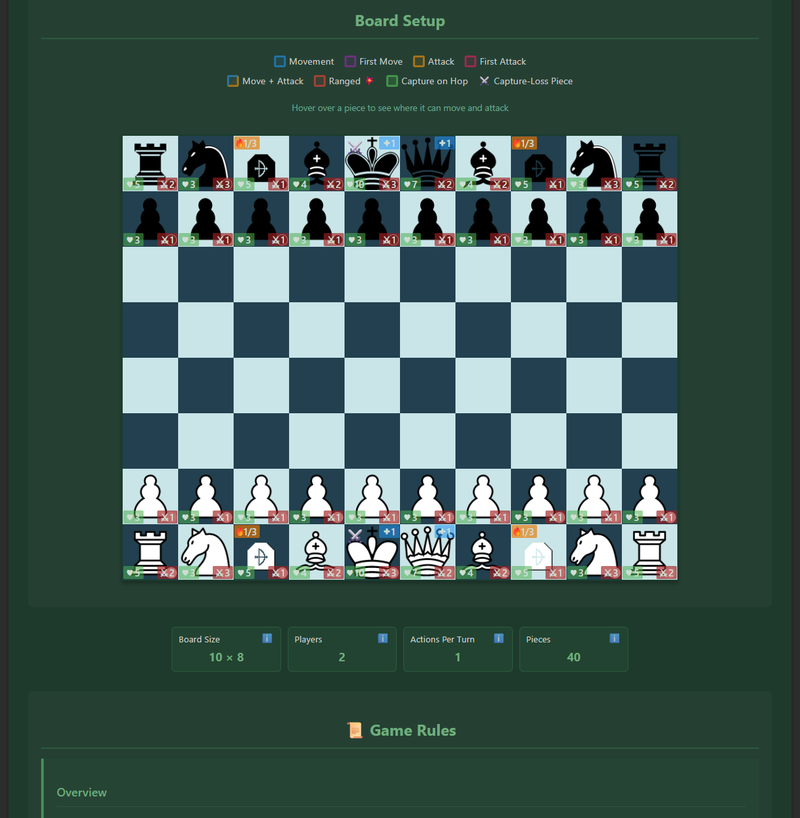
Crazy example game I created with HP/AD/Regen/Burn (and you can turn off badge display - more is explained below):
The really fun part is how you can customize each piece after its on the board:
- You can of course set the color/image/player of the piece. Currently this site supports only 2 players, but eventually I'd like to get that number up to 8 or at least 4.
- End game on checkmate/capture if you have those options selected in the win conditions section.
- Custom castling partners or move distance for the castling piece.
- Stats! You can give the piece HP, Attack Damage, Regen, or Burn. Most of these are self explanatory, but might as well explain: HP is how many hits it can take before getting capture. If you attack a piece but don't kill it, the move is not executed, and the AD of the attacking piece is subtracted from the HP. The default HP/AD is just 1. Regen - you can set how much each piece heals per turn, per piece. Burn - you can set how much continuing damage and for how many turns the piece takes after being hit by a piece with Burn damage. Default for these two is 0.
- There's also a setting to make pieces stop one square before the piece getting attack if the HP is not 0 or lower, instead of cancelling the move.
- Ability to show the stats on the board per piece, or hide them.
- Ability to be immune from capture or damage
- 3 new abilities: Ghostwalk, Trample, and Die on Capture (good for Atomic chess). Ghostwalk means it can pass through any piece, trample means that on the way to other pieces, it damages all in its path. There's also trample radius and attack radius, which basically do the same thing - adds a radius of damage around the piece, but the trample one is only compatible with trample, the regular one would make the game function exactly like Atomic chess.
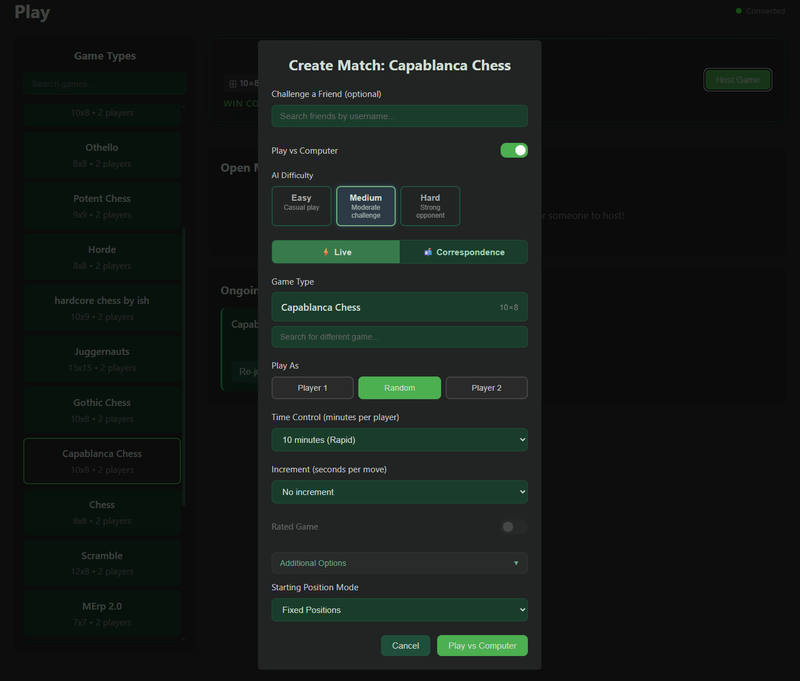
- 6 randomization/starting position modes that can get pretty wild: Fixed (the pieces are on the board in the same way you set them up), back row only mirrored randomization (the closest to chess960, although chess960 has some exceptions that I haven't added), full mirrored randomization (the pawns are mixed in with the random positions using chess as an example, but both players get the same combination), independent randomization (both players do NOT get the same position, but their pieces are still randomly distributed among the starting squares), shared starting squares (this one is crazy - your pieces and their pieces are randomized among all starting squares), and the craziest: full board randomization (literally each piece gets randomized to a random square on the board - you could start the game in checkmate).
Host game modal vs a medium computer:
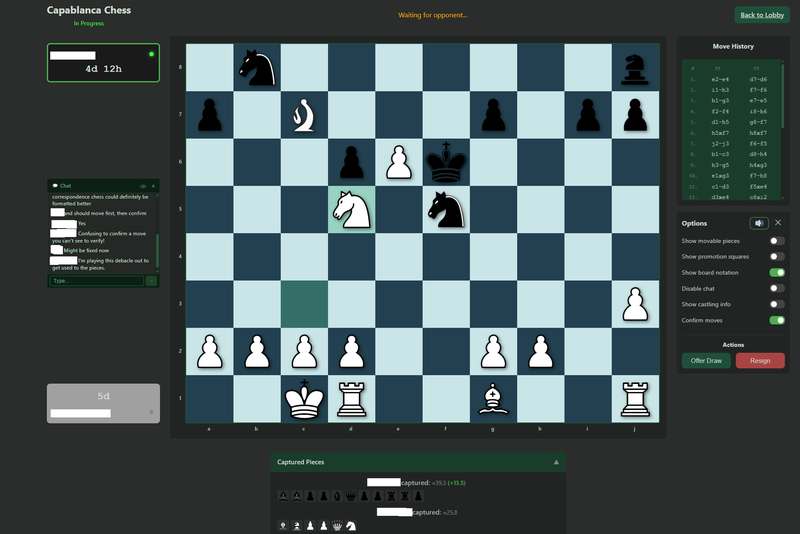
Correspondence game on the site that I'm currently in (as we chat about the game/things I could be doing better with the site):
That covers about all the customization you can do at the moment, but I'm constantly updating the site, and always enjoy feedback. The site has an FAQ section, forums, ability to friend people, and is friendly to those that don't want to create accounts. You can play via invite code without an account. It's always going to remain free to play, and ad-free as long as I can support it. Other features: there's a generalized ELO if you play rated games that all games factor into. I'm going to one day add a per-game ELO but haven't had the players to feel like it's necessary. There's a large number of time control options, in addition to correspondence chess. You can play the computer, but the bot is pretty bad right now (I'd love advice on how to code a better generalized bot). Another random feature is the sandbox, where you can play around with adding pieces to any sized board. One day the site will support tournaments, and honestly, there's a long to-do list.
You might ask - do you use AI? And the answer is yes, yes I do use AI to help me. It started as a non-AI project, I only discovered Claude like 6 months ago, which is probably on the slow side compared to most software developers. I've been blown away at how good AI is at coding; it's much faster than humans. I'm trying to be very specific with prompts and do my due diligence to make it work exactly how I want it to work, and apologies if there are places on the site that might not look very human-made. Did I use AI to help write this post? No lol. I actually went as far as posting it to GPT and didn't like the suggestions, so this thing is entirely written by me, (okay, except for one suggestion that helped write one line near the beginning of the post :D). You can tell by the lack of organization.
Like Lichess, the site is very secure and values privacy/will never sell your data if you do choose to make an account. Also, I made a sign in with Lichess button, which you can see at gridgrove.gg/login.
TLDR: GridGrove is a platform for creating and playing custom games that have never been created before, or old classics, whichever you want. There's a ton of stuff you can do with the site, and I'm excited for the future. I'm very open to suggestions.
Thanks for the feedback! Happy to answer questions, I'll check back every once in a while.