
Pieces of wood
Welcome to my 2nd blog post in my OTB Adult Improvement journey. This game features a nice positional win which reminded me of a theme in the book Under The Surface by Ján Markoš.
As a part of my chess learning, I have been reading a few different books to try to improve my strategic understanding of the game. The first is Lessons with a Grandmaster by Boris Gulko and Joel Sneed which I have been steadily working through as time allows. The second one, Under the Surface by Ján Markoš, is one that I picked up off my shelf because I was going to be traveling for a conference, and the book is written in such a way that it's easy to read without a board (many diagrams, few variations). This made it the perfect way for me to pass time on the flight. Luckily for me, some of my recent learnings from that book seemed to apply here in this game.
Let's get into the game!
For a bit of tournament context before I dive into the moves, this is round 3 of a weekly tournament. My score is currently 1.5/2 (1 win, 1 bye). After playing a decent game last week, I was feeling pretty good coming into this one. I had a fairly decent day and was much better rested compared to last week where I had been recently sick. Furthermore, I was looking forward to getting a decent pairing where I would be playing someone closer to or above my rating.
1. d4 Nf6 2. Nf3 g6 3. g3 Bg7 4. Bg2 O-O 5. O-O d6 6. c4 Nbd7 7. Nc3 e5 8. e4 c6
According to the database a fairly common variation in the Fianchetto variation of the King's Indian. I haven't really studied d4 openings from the black side that much, so I'm basically on my own (and have been for the most part). The only thing I know (or think I know...) is that black doesn't go for the typical plans in the King's Indian against this setup.
9. Be3 Qe7 10. Qd2
I wanted to play Ng4 immediately after Be3 but decided against it since the bishop could just retreat. When white blocked the escape of the bishop with Qd2, I was very happy.
10... Ng4 11. Bh3
Challenge: Black to play and win material
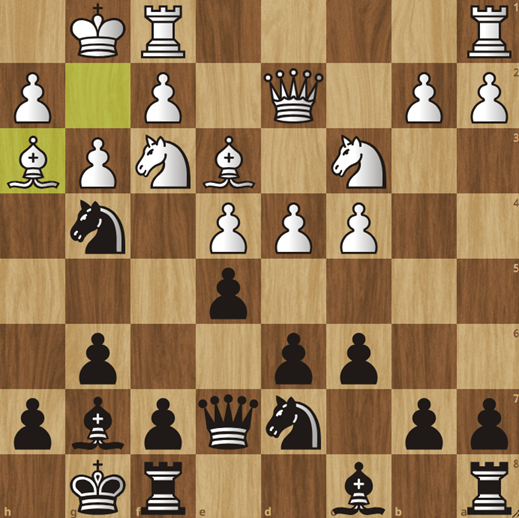
Answer: 11... Nb6! White has no way to guard the c pawn white also defending against potential tactical ideas involving the bishop on h3 and knight on f3. The engine suggests white's best move here is to play the bishop back to g2 and lose the c pawn for free!
11... Nxe3
I played this move very quickly. I probably should have taken a bit more time to try to find the idea with Nb6. That being said, I did look at this position for a bit after the game to try to find some way to win material due to the loose pieces, but I didn't consider a move on the other side of the board at all until I turned the engine on. So I likely wouldn't not have found this during the game even if I spent more time...
12. Qxe3 exd4 13. Nxd4 Ne5 14. Bxc8
I'm presented with a choice. I can take with my a-rook with plans of playing on the kingside or take with the f-rook and play on the queenside. I took a few minutes here to decide which I thought was better, which was tough because I figured there was merits to both. Turns out the engine agrees with that as well! Ultimately, I decided that despite white's weakened king position with those loose light squares, my bishop was better positioned for support queenside play, so I took with the f-rook. I included a potential variation with taking the other way (not a 100% engine approved line, but it's still slightly better for black) in the analysis board. Feel free to explore.
14... Rfxc8 15. Qe2 Rab8 16. Rad1 Nd7 17. Rfe1 Nc5 18. Qe3 a5 19. a3 a4
I had a feeling that I had been slightly better for most of this game, but once I got in a4, this feeling was solidified. My pawn on a4 is extremely useful in ensuring that white's b and c pawns are long-term weaknesses. It's possible that my a-pawn is a bit loose, but it's hard for white to add more attackers. Furthermore, I have plans of going after white's e-pawn. Due to all of this, my position felt much easier to play, and I was struggling to try to come up with plans for white in the moment. So I spent most of my time focused on my own ideas rather than try to guess what white might try to play.
20. Nf3 Re8 21. Nd2 Qc7 22. Rb1 Ra8 23. Re2 Ne6 24. Nf3 Nc5 25. Nd2 Re7 26. Rbe1
It was this position that reminded me of a concept I had recently ready about in Ján Markoš's book. In one of the chapters, he discusses the Three Faces of a Piece:
- An Active Tool
- A Vulnerable Creature
- A Piece of Wood
The first two are fairly self-explanatory, but what he is referring to when he described a Piece of Wood is that the piece takes up physical space on the board. As a result, no pieces can be on the same square or path through that square on its way to another square. Seems very obvious, but to me it was a fascinating consideration that isn't really discussed as much when evaluating piece placement. Often we're guided to "ask questions to the pieces. " Is it happy or sad? Does it have a role in the position? Etc. But it's much less common to think about how the pieces is influencing its fellow pieces. I think the example he provides paints a clearer picture. Consider the following position from Karpov-Andersson at the World Junior Championship in 1969: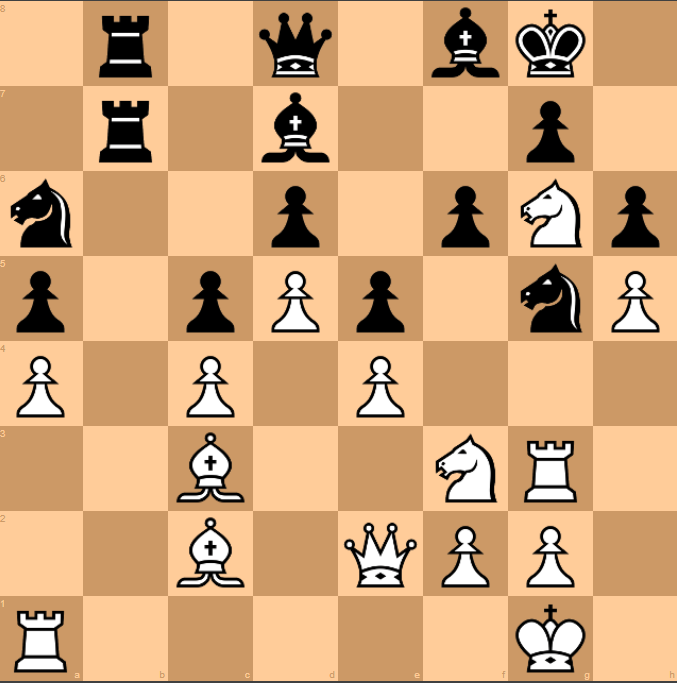 In this position, Andersson played 31...Nb4. While this is a great square for the knight (and admittedly the best move according to the engine), the knight blocks the black rooks on the b-file, acting almost like a cork keeping them trapped. The knight is a piece of wood that the rooks can't pass through.
Coming back to the position in my game, the knights are cutting off the rest of white's pieces from the defense of the queenside, so I decided to take advantage of that.
26... Qb6 27. Nf3 Qb3!
White defended the b-pawn, but missed that I can also infiltrate to attack the c-pawn. Unfortunately for white, this pawn can't be defended. You would love to play Rc1 here, but the knight on c3 blocks the defense!
28. Nd4 Qxc4 29. Rd2 Rae8 30. Qe2 Qxe2 31. Rexe2 Nxe4 0-1
My opponent resigned here. I thought it might be a bit early for that since anything can happen, but I was not going to complain about a win! Looking at it further, I'm up two pawns with a much better position and more play, so it makes a bit of sense to resign.
Takeaways!
I was pretty happy with this win since I seemed to play a really nice game outside of missing Nb6. For some reason, I also find the more positional/strategic wins a bit more satisfying than I really nice attack (which is odd because it's not really my style!). I think my main takeaways from this game are:
- I need to take my time in the opening. A few extra minutes to try to blunder check my opponent could have potentially gone a long way, though again I'm not 100% sure I found have found Nb6.
- It's not enough to think about the placement of your pieces in a silo. You need to consider how the piece is placed in the broader context of the board, and how well it coordinates with or hinders your other pieces.
- You don't need to calculate on every move. I didn't discuss this, but there were only a few positions in this game where I actually calculated a handful of variations. Since this game a bit more quiet, I focused mostly on small 1-3 move sequences to improve my pieces (e.g., Nd7-Nc5, Qc7-Qb6) which saved me a lot of time. I had a slight time disadvantage out of the opening, but by the end of the game I was up on the clock which could have played a role had the game continued.
You may also like
 CM HGabor
How titled players lie to you
This post is a word of warning for the average club player. As the chess world is becoming increasin… thibault
How I started building Lichess
I get this question sometimes. How did you decide to make a chess server? The truth is, I didn't. ChessMonitor_Stats
Where do Grandmasters play Chess? - Lichess vs. Chess.com
This is the first large-scale analysis of Grandmaster activity across Chess.com and Lichess from 200… IM datajunkie
You’re studying chess openings the wrong way (do this instead)
If memorising opening lines made you stronger, many club players would be masters. Mike-Shea