
ChessSonar: Mapping the Invisible Forces of the Board
You look at the board and see pieces. I look at the board and see radiation, turbulence, paralysis, and gravity. The position is already decided — you just don't know it yet.
The Problem Every Chess Player Knows
You've been there. You stare at the position after your opponent's move. Something feels wrong, but you can't articulate what. The engine says -1.3, but why? The evaluation bar is a number — it tells you that you're worse, not where the disease lives, not how to treat it.
Standard analysis tools give you a centipawn score (a number without context), computer lines (variations without understanding), blunder highlights (consequences without causes). What they don't give you is a map of the position. A way to see the invisible forces that grandmasters sense intuitively: the radiation of long-range pieces bleeding through their own pawns, the zones where the position is one move from explosion, the pieces that are already dead but don't know it yet.
I've been working on something to fix that. It's called ChessSonar, and it's still in development — but I want to show you what it can do.
What Is ChessSonar?
ChessSonar is a positional analysis toolkit that doesn't just evaluate a position — it maps it. Inspired by sonar technology that reveals what's hidden beneath the surface of the ocean, ChessSonar reveals what's hidden beneath the surface of a chess position.
It generates 11 distinct visual maps, each exposing a different layer of positional reality. Let me walk you through them using a real position:
FEN: 2k1r3/1rp1P1Q1/ppb2P1p/1qp5/3p2P1/P2P1N1P/4R3/3BKR2 b - - 0 33
Black to move. Middlegame. Let's see what's really going on here.
The Seven-Dimensional Radar
First, the overview. ChessSonar evaluates seven independent components of the position — material, pawn structure, king safety, piece activity, space, center control, and outposts — and visualizes them all on a single radar:
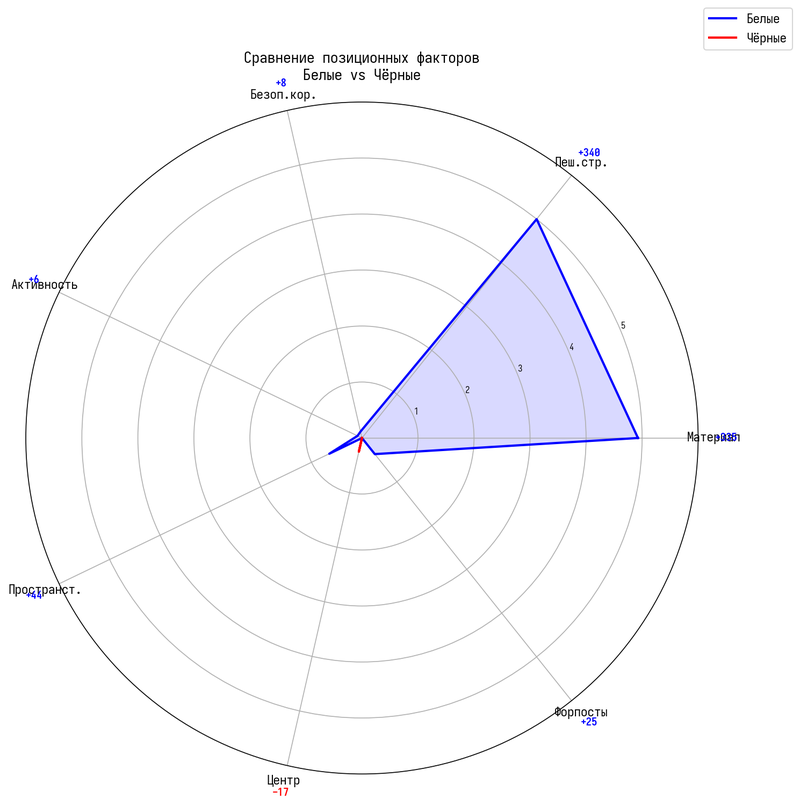
Right away you can see: White dominates in pawn structure and space. Black is slightly better in center control. But what does that actually look like on the board?
Here's the component breakdown:
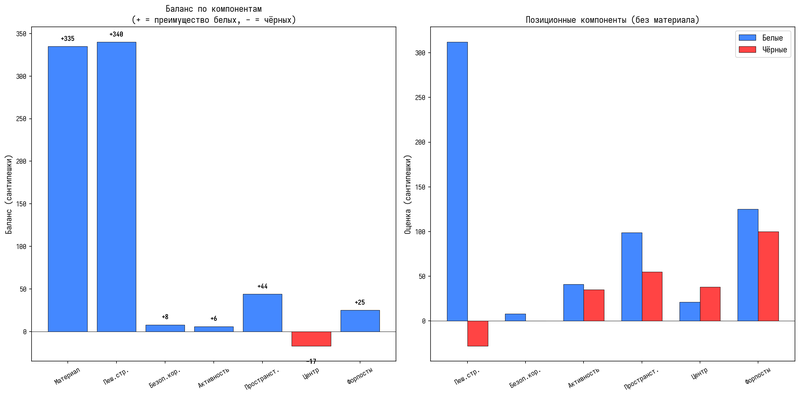
+340 for pawn structure. +44 for space. These aren't abstract numbers — let me show you where they live.
The Wounds and Fortresses
A weak square is a square that no pawn of yours can ever defend. It's permanent. It's structural. And if your opponent plants a piece there, it becomes an outpost — a forward operating base that cannot be dislodged.
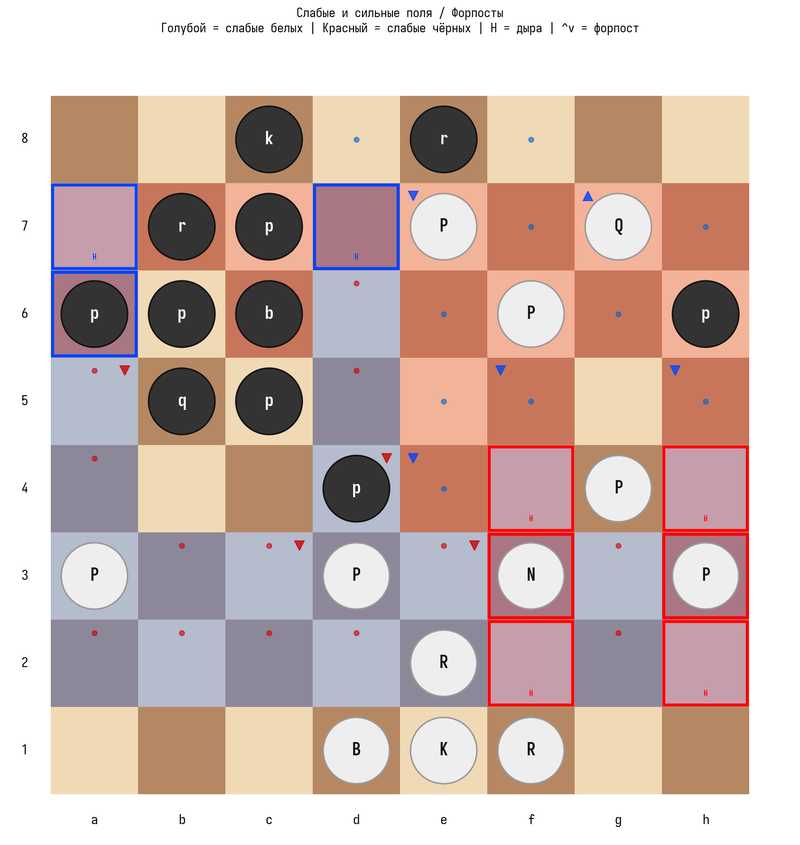
Look at Black's kingside. Those holes on f2, f3, f4, h2, h3, h4 — they will never be defended by Black pawns. This isn't a temporary problem. It's geological. Meanwhile, White has outposts on e4, f5, e7, and g7 — the knight on f3 and queen on g7 are sitting on fortresses. Black can't touch them.
This is what +340 in pawn structure looks like when you make it visible.
The Storm Approacheth
King safety isn't just about checkmate threats. It's about structural vulnerability — the pawn shield, the open files nearby, the enemy pawns marching in a storm, the proximity of enemy heavy pieces.
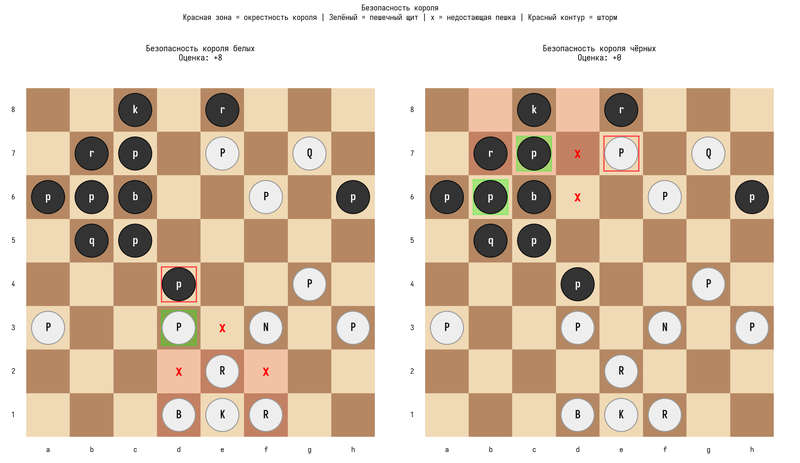
White's pawn e7 is a storm pawn — it's already on the 7th rank, two steps from queening, and it's right in front of Black's king. The tropism map shows the enemy queen on g7 just 4 squares from the Black king. That's not a coincidence — that's gravity.
The Skeleton of the Position
Philidor said pawns are the soul of chess. The pawn structure determines everything: where pieces can go, what squares are weak, whether the endgame is winnable.
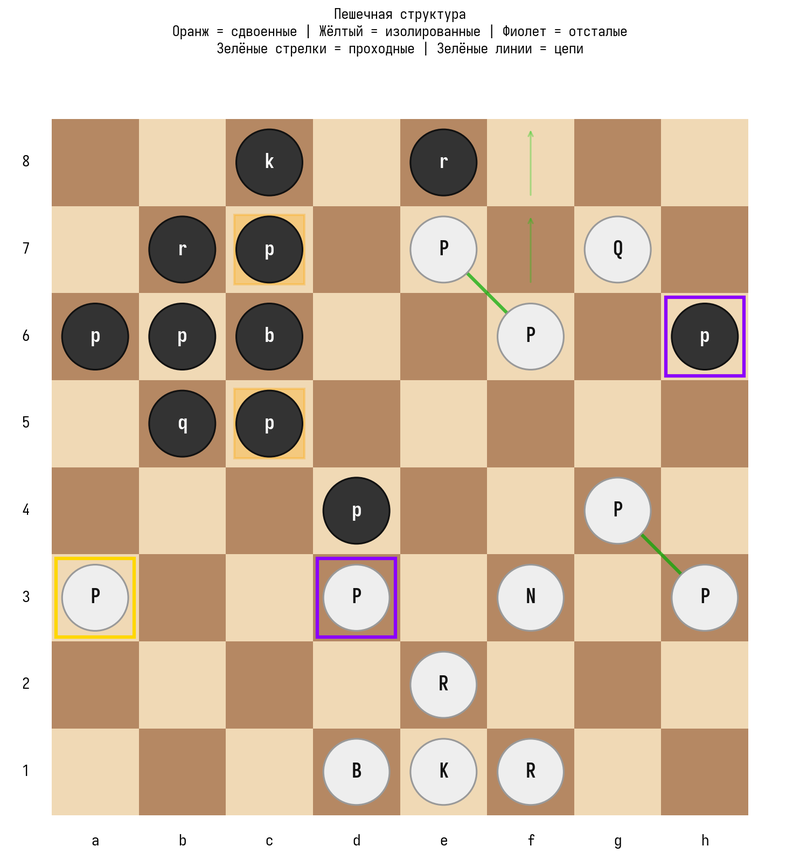
White has two passed pawns — f6 and e7. Let that sink in. A pawn on the 7th rank that can't be stopped by enemy pawns. And behind it, a connected pawn on f6 providing reinforcement. Meanwhile, Black is suffering: doubled c-pawns, an isolated h6 pawn, a backward pawn. The skeleton is broken.
What Should I Actually Do?
This is where it gets practical. ChessSonar generates concrete plans — not just "improve your pieces" but actual named plans with candidate moves, key squares, and priorities:
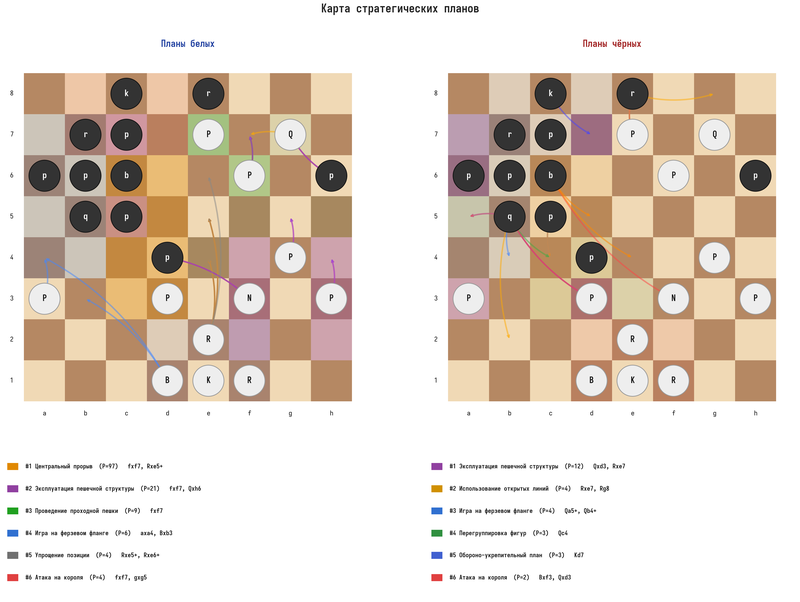
Two boards — one for White's plans, one for Black's. Each plan tells you what to do, why it works, and which moves to consider.
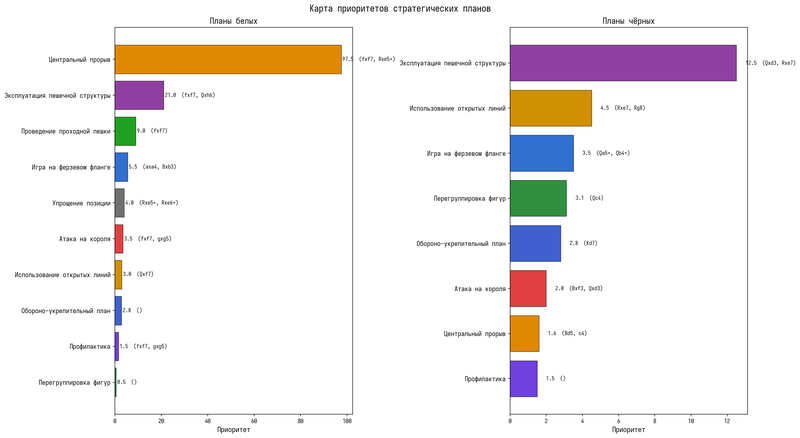
Now It Gets Interesting
Everything above — weak squares, king safety, pawn structure, plans — these analyze what you can already see on the board, just in a more structured way. But the real innovation of ChessSonar starts here. The next four maps analyze what you can't see.
The Radiation Map
This is the map that gave ChessSonar its name.
A standard attack map stops at the first piece in the way. Rook on e2, pawn on e4? Attack map says the rook "attacks" e3 and e4, then stops. But any strong player knows that rook is radiating pressure through e4 to e5, e6, e7, e8. The pawn might move. It might be captured. It might be sacrificed. The influence doesn't vanish — it attenuates.
ChessSonar traces rays from every sliding piece through blockers, with attenuation:
- Own piece on the ray → attenuation × 0.3 (hidden potential — the piece might move)
- Enemy piece on the ray → attenuation × 0.5 (pin or through-attack)
- 2+ blockers → ray terminates (pressure negligible)
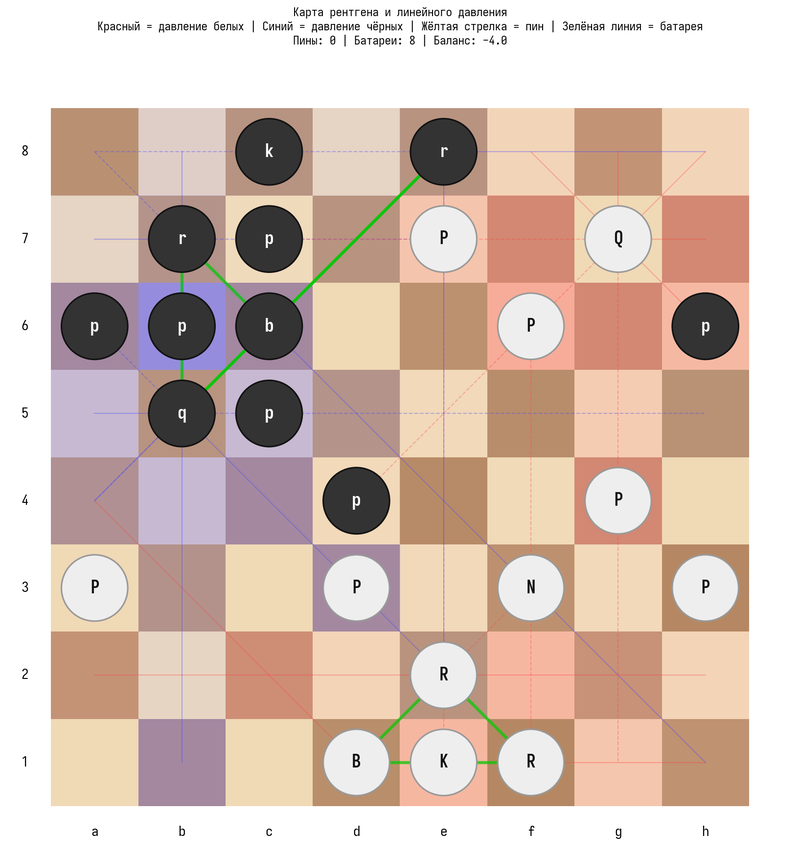
The result is a heat map of the board's "background radiation" — invisible pressure that grandmasters feel but no standard tool shows.
The map also automatically detects pins (pieces pinned to their king through a shield piece) and batteries (two or more sliding pieces aligned on the same line — queen + rook on a file, bishop + queen on a diagonal).
In this position, the X-ray map reveals White's queen on g7 is radiating enormous pressure through the entire kingside, and there's a bishop-rook battery on the e-file. These aren't "attacks" in the traditional sense. They shape the position like gravity shapes orbits.
The Turbulence Zones
"In calm water, every ship is a good sailor."
Some zones on the board are turbulent — places where multiple pieces from both sides converge, where the balance is delicate, where one move can trigger a cascade. Other zones are calm — you can ignore them.
ChessSonar identifies these zones using a physics-inspired model:
- Concentration — how many pieces from both sides converge on a square
- Balance — how evenly matched the forces are (equal forces = maximum tension)
- Tension — concentration × balance
- Gaussian smoothing — reveals connected zones of turbulence, not just individual hot squares
- Hanging pieces — unstable exchanges that amplify local tension
The map also computes a global Position Fragility score, based on research by Barthelemy (2024, Physical Review E), which models the position as an interaction graph — pieces attacking pieces — and measures how fragile the entire structure is:
- CALM (fragility < 15) — play positionally, take your time
- TENSE (15 < fragility < 30) — sharpen your calculation
- CRITICAL (fragility > 30) — one mistake triggers a cascade
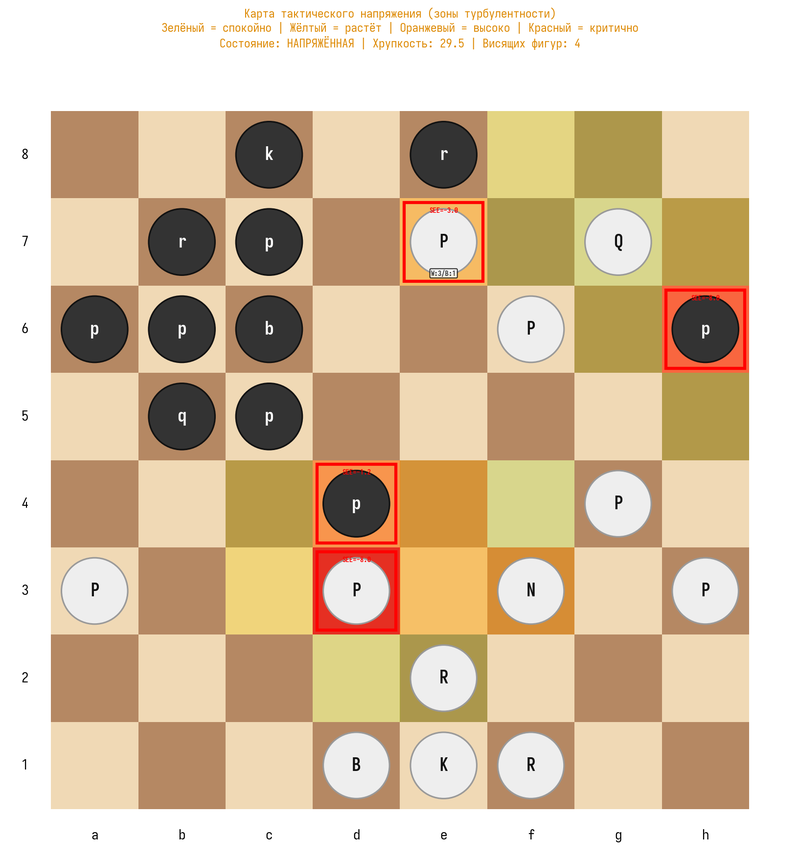
Knowing which state you're in is perhaps the most important meta-decision in chess. In a CRITICAL position, you calculate every line to the end. In a CALM position, you play positionally and trust the long-term logic. ChessSonar tells you which world you're living in.
The Disabled Pieces
Here's a question most players never ask: Which pieces on the board are already dead?
Not captured — just disabled. A rook trapped behind its own king. A bishop with all its diagonals blocked by its own pawns. A knight on the rim with no safe squares. These pieces exist on the board but contribute nothing.
ChessSonar measures for every piece:
- Theoretical max mobility — how many squares the piece could reach on an empty board
- Actual mobility — how many legal moves it has
- Safe mobility — how many moves don't leave the piece hanging
- Restriction ratio — what fraction of the piece's potential is neutralized
And then it identifies:
- Bad bishops — 3+ own pawns blocking their diagonal color
- Trapped knights — on the rim with 0-1 safe moves
- Blocked rooks — stuck behind their own king
- Disabled pieces — zero safe mobility, completely dead
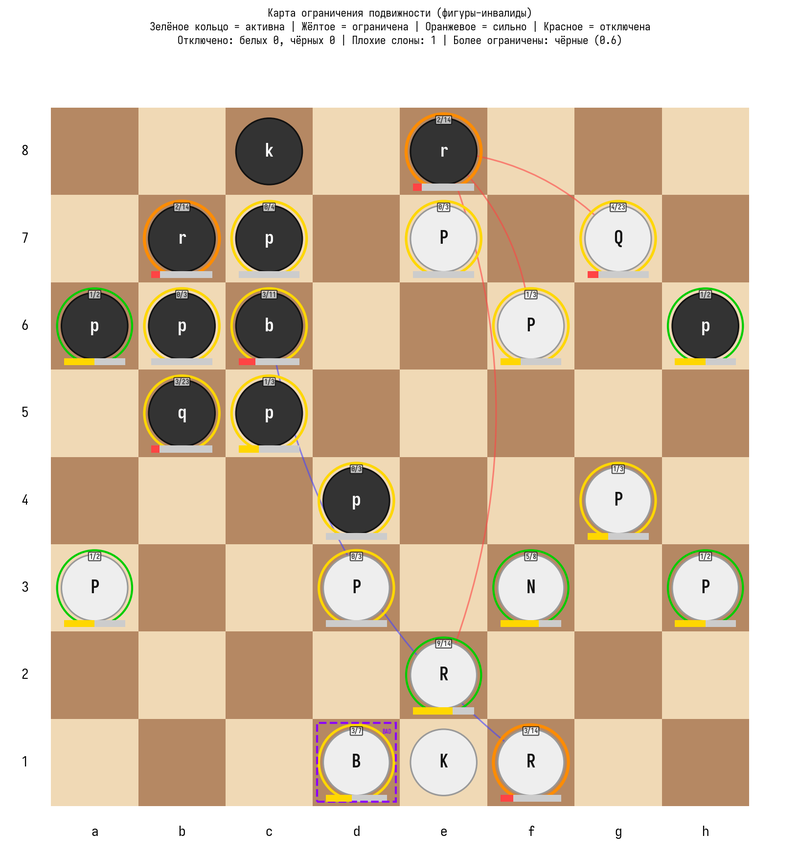
This one changes how you think about positional play. Instead of "I should improve my worst piece" (vague), you can see which piece is worst, why it's restricted, and which enemy pieces are doing the restricting. A fuzzy heuristic becomes a surgical instrument.
The Endgame Barometer
The most terrifying question in a middlegame: "Should I trade queens? If I do, is the endgame winning or losing?"
Most players answer by gut feeling. ChessSonar answers with math — specifically, the Tapered Evaluation framework from Stockfish, which evaluates the position twice (once for middlegame, once for endgame) and shows how every possible exchange shifts the balance:
- Queen exchange impact — what happens if queens come off
- Rook exchange impacts — each rook trade analyzed separately
- Endgame factors — passed pawns, connected passers, pawn islands, doubled pawns, king centralization, bishop pair
The result is a Barometer:
- 🟢 FAVORABLE_EXCHANGE — the endgame favors you. Trade pieces!
- 🔴 AVOID_EXCHANGE — the endgame favors your opponent. Keep pieces on!
- 🟡 NEUTRAL — exchanges don't change much
Image limit in blog im sorryy :)
[IMAGE WITH BAROMETER XDDD.png]
In this position, the barometer is clear: White's two passed pawns (f6 and e7) become devastating in the endgame. Every piece exchange tilts the position further toward White. White should trade aggressively; Black should avoid exchanges at all costs. That's not a feeling. That's math.
Why This Matters
Chess engines have been getting stronger for decades. But they've been getting more opaque, not more transparent. Neural network engines like Leela and Stockfish NNUE are incredible at finding the best move, but they tell you almost nothing about why.
ChessSonar takes the opposite approach. It's not trying to find the best move. It's trying to make the position legible — to give you a map of the invisible forces so you can make your own decisions with grandmaster-level understanding.
Think about the difference:
- Traditional: "Your evaluation is -1.3" → ChessSonar: "Your queen is radiating pressure through g7 into the entire kingside"
- Traditional: "This is a blunder" → ChessSonar: "This zone is critical — one move triggers a cascade"
- Traditional: "Improve your worst piece" → ChessSonar: "Your rook on b7 is disabled by the queen on b5 — here's exactly which enemy pieces are restricting it"
- Traditional: "The endgame is better for White" → ChessSonar: "Trading queens improves White by +47 cp because of the e7 passed pawn — trade aggressively"
What's Coming
ChessSonar is still in active development. I'm not releasing it yet — there's still a lot of work to do. But here's what I'm building toward:
- Interactive web dashboard — all 11 maps in one interface, no installation needed
- Game-wide analysis — track how the maps evolve move by move through an entire game
- Training mode — test yourself: "Where is the highest tension zone?" then reveal the map and compare
- Lichess integration — analyze your Lichess games automatically with all maps
- Opening repertoire analysis — which openings lead to positions with favorable maps for your style
If you're interested in following the project or contributing ideas, stay tuned. I'll share more as it develops.
The Bigger Picture
Every strong player has said something like: "I don't calculate — I see." Capablanca. Karpov. Carlsen. They don't see moves. They see structures, pressures, forces, tensions.
ChessSonar makes those forces visible. It's not a crutch — it's a lens. And once you see the position through this lens, you can't unsee it.
The board was never empty. The forces were always there. You just didn't have sonar.
All maps in this blog were generated from the position 2k1r3/1rp1P1Q1/ppb2P1p/1qp5/3p2P1/P2P1N1P/4R3/3BKR2 b - - 0 33 (Black to move). ChessSonar is a project in development — not yet released.
You may also like
 Lyrogen
Van't Kruijs: Транспозиция в Бенони
Когда один тихий ход 1.e3 превращается в структуру Бенони, а партия завершается блестящей жертвой сл… Lyrogen
Анализ партии Гроссмейстера.
Формат: Bullet 1+0 | Дебют: Староиндийская защита, система Фианкетто, Венгерский вариант (E64) Lyrogen