
Mastering the Mind: How to improve your chess Psychology?
Ready to stop letting your nerves call the shots? Here is a quick, actionable breakdown to help you master your chess psychology, stay calm under pressure, and turn your mental game into your ultimate weapon.
You’ve memorized your opening lines, you crush tactical puzzles every morning, and you know exactly how to activate your pieces. Yet, during an actual game, your heart rate spikes, you make a panic-move in time trouble, or you completely collapse after a single blunder.
Sound familiar?
Chess is often described as a battle of logic, but in reality, it is a battle of nerves. Your chess knowledge is only as good as the mental framework holding it together. If your chess psychology is fragile, your performance will be too.
To take your game to the next level, you need to train your mind just as hard as your board vision. Here is a practical guide to mastering your chess psychology.
PS This is inspired by a video from GothamChess
1. Adopt a Growth Mindset (Ditch the Rating Obsession)
One of the biggest psychological traps in chess is tying your self-worth to a four-digit number. When you care too much about your rating, every game becomes a high-stakes crisis.
*Shift your focus: Treat ratings as delayed feedback, not a real-time judgment of your intelligence.
Reframe losses:A painful loss is not a failure; it is a diagnostic tool. Your losses show you exactly what you need to study next.
"You may learn much more from a game you lose than from a game you win. You have to lose hundreds of games before becoming a good player." — José Raúl Capablanca
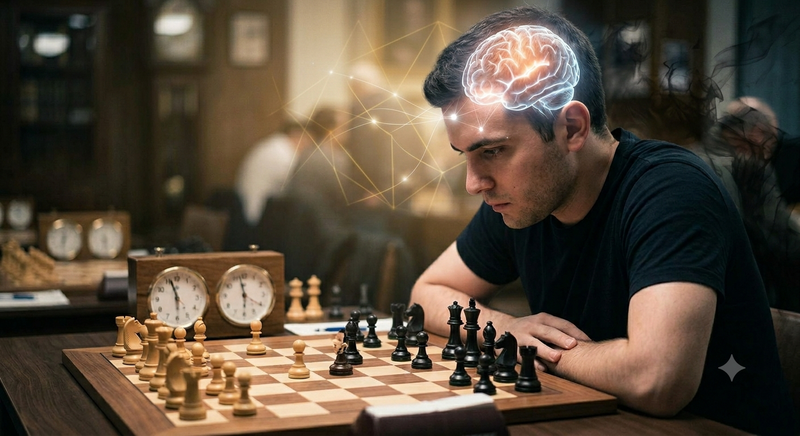
2. Implement the "Sit on Your Hands" Rule
Emotional instability is the root cause of blunders. Have you ever noticed that right after you make a mistake, you immediately make an even worse move? This is called "tilt," and it happens when your brain is hijacked by panic or frustration.
*Create a physical barrier: If playing over-the-board, physically sit on your hands to stop yourself from making impulsive, reactionary moves. If playing online, move your hand completely off the mouse or keyboard after your opponent moves.
The 3-Question Protocol: Before making any move, force yourself to answer these three questions:
1. What is my opponent's immediate threat?
2. What changed in the position after their last move?
3. Is my intended square actually safe?
3. Play the Board, Not the Rating
It is incredibly easy to play the *person* across from you rather than the pieces on the board.
*The Overconfidence Trap: When playing a lower-rated opponent, players tend to relax, play too quickly, and assume the win will come easily. This leads to careless blunders.
*The Intimidation Trap: When playing a higher-rated opponent, players often become overly defensive, assuming their opponent will see every tactic. They play with fear and miss winning chances.
The Fix: Imagine every game is played against an anonymous opponent. The pieces move the exact same way whether a grandmaster or a beginner is pushing them. Focus purely on the needs of the position.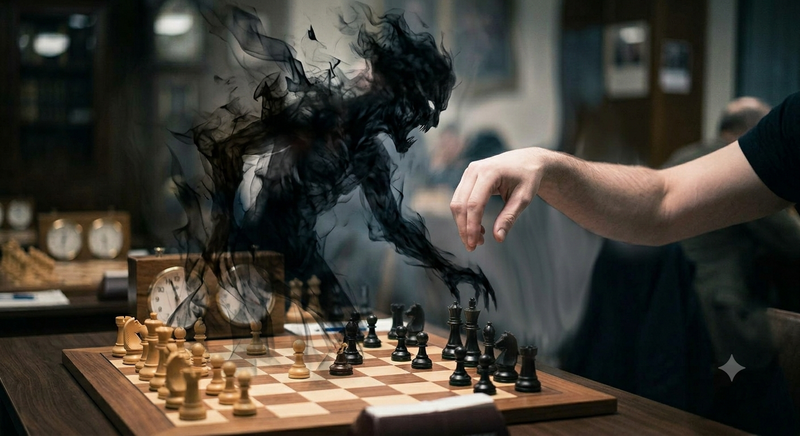
4. Develop a Post-Blunder Recovery Routine
Everyone blunders—even World Champions. What separates great players from average ones is how they handle the aftermath.
If you realize you’ve made a terrible mistake, do not immediately make another move to try and "fix" it. Instead, execute a recovery routine:
Take a physical break: Take a deep, slow breath. If you are playing a longer tournament game, stand up, grab a sip of water, and look away from the board for 30 seconds.
Reset the evaluation:** Accept that the evaluation of the position has changed. Stop wishing for the position you had three moves ago. Your job now is simply to find the absolute best move for the *current* position.
Fight on: Opponents slip up when they think the game is easily won. Many "lost" games can be saved if you force your opponent to work for the win.
5. Master Your Time Management
Time trouble is an absolute psychological killer. It causes panic, which destroys analytical thinking.
Allocate your time by phase: Have a general roadmap for your time. For example, in a 90-minute game, aim to spend 15–20 minutes on the opening, 40–50 minutes on the complex middlegame, and save the rest for the endgame.
Trust your preparation:Don't spend 10 minutes recalculating an opening line you already know just because you feel anxious. Trust your study and keep moving.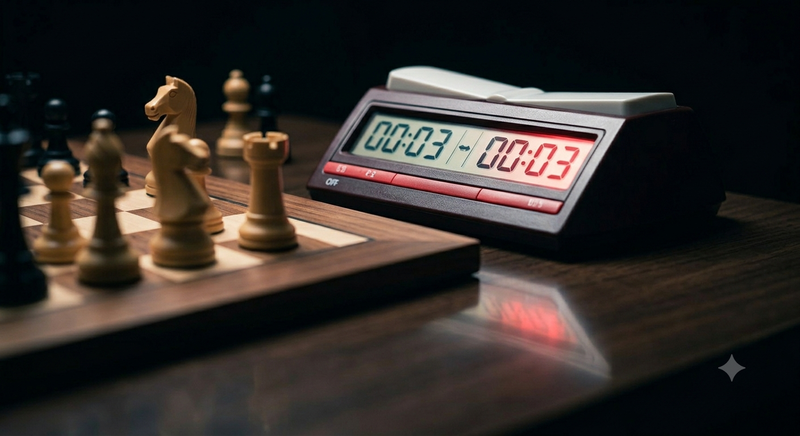
Summary Checklist for Your Next Game
Pre-Game Phase: Remind yourself: "I am here to learn and play with confidence."
During Game Phase: Look at the board with fresh eyes every single move; ignore the ratings.
After a Blunder: Breathe, reset, and force the opponent to prove they can win.
Post-Game Phase: Step away to cool down before using an engine to analyze.
By treating mental toughness as a skill that requires practice, you will notice fewer unforced errors, better resilience in tough positions, and ultimately, a much higher level of enjoyment from the game.
What is your biggest psychological hurdle when playing chess?
