
A Response to the Study Search Problem...
Searching through Lichess studies often means having to dig through an unannotated and meaningless mess. It's a pain to find the actually educational, helpful study you're looking for.
TL;DR: So, here's an answer to it: The Chess Study Library. Feel free to check it out, use it, and share your thoughts. Completely free, no log-in or anything btw. Below talks about why it was created and how it works.
The Problem
Lichess has a fantastic feature; lichess studies: https://adjva4.dpdns.org/study. In my opinion this is lichess's most educational feature. People share their knowledge, you can learn any opening, or a lesson on strategy, endgame, or pretty much everything. The problem is, although there's a lot of excellent learning content, there's also a lot of not really great content. This includes blank studies, useless studies, unannotated studies, nonsense studies, or even copied studies. This results in the really great content getting buried and most people won't find it. The number of likes also doesn't reflect quality, as many high-effort studies have little to no likes because they got buried.
For an example I'll share the following; let's say I want to find a study to learn the Italian Game. So, I'll type it in the lichess study search bar and see what we'll get.
 Disclaimer: No ill will is intended toward any specific creator; these are simply examples of the study search problem.
As you can see, I'm not really finding what I'm looking for here.
Answers
There have been some responses of users to fix this problem; that is, help promote the good stuff.
Teams: There have been lichess teams set up to share high-quality work from creators with their members. This worked quite well and did boost high-quality work upon their release. The only thing is, this was short-term; they received a boost, but as the studies got older, they were buried too, and people stop reading older team messages. As the collection becomes larger, it also becomes impossible to navigate within team messages.
Servers: These essentially worked the same way as the lichess teams but could also list studies in text channels. The problem is that as the collection grows, updating and navigation become problematic.
So I was really trying to find a type of "fix" for this. We had a large collection of high-quality, original work that the creators put a lot of effort into, but I wanted to find the best way to make it helpful for everyone. Then I came across a movie website and thought: why not make the same thing but for chess studies? Then came The Chess Study Library. This is basically, an easy-to-navigate, easy-to-update, a pain to make, simple-layout database consisting of only high-quality, educational, studies, as each study that gets in has been reviewed.
How it works
Below is what it looks like when you go to the website: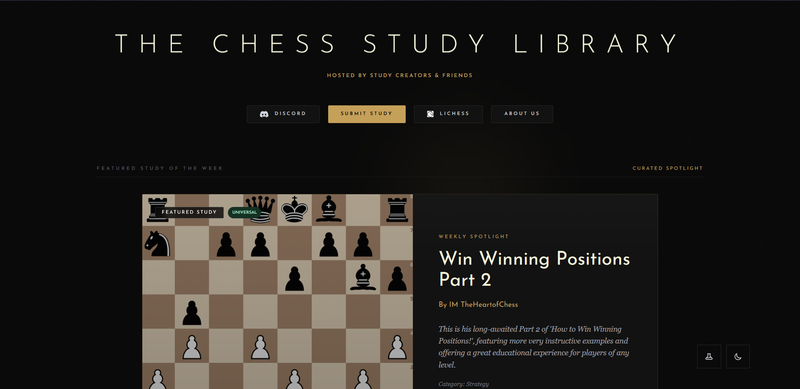
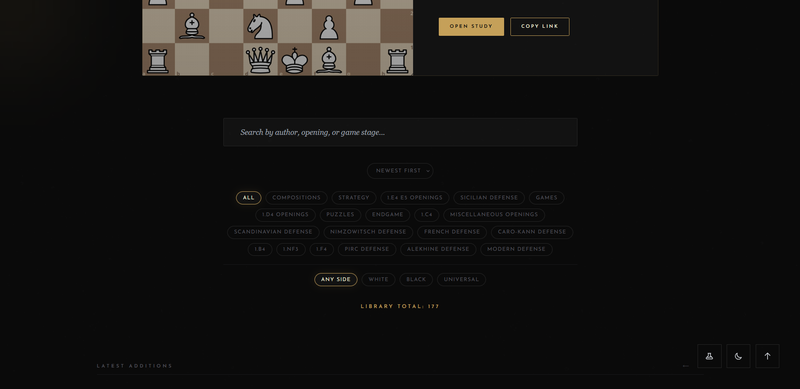
 Three screenshots, so ignore the moon button and the button next to it appearing thrice.
The website is linked directly to a spreadsheet full of educational, high quality studies. If a study is added into the spreadsheet, it gets instantly added on the website.
- Search and Filter: In the search bar, you can type anything you’re looking for: an opening, a specific creator, or a variation. You can also filter by side (White/Black). A study is labeled with the "Universal" tag when there's no specific side focused on; strategy, middlegame, puzzle, and endgame, etc studies.
- Direct Access: Simply click on the study you want to learn, and you’ll be directed straight to the lichess study and you can start learning.
- Curation Tags: You will also see studies marked with 'Staff Picks', something like 'Easy', or specific 'Viewer Notes' which might be helpful.
- Featured Study: On the top of the page a featured study of the week is listed to give previous work attention.
- Author Pages: You can't see it in the images above, but when you click on a username of a creator, you'll see his author page. Here you can see a list of his work, bio, style, and other stuff.
- "What's that weird looking beaker button?": This is the "Surprise Me!" button (next to the moon button), it will direct you to a completely random study from the collection. :)
What do we mean by "High Quality"?
To us, a high-quality study must have a sufficient amount of annotations. That is, explanations tackling things like why a move is played (are there tactical ideas, is something being threatened, etc), why other moves don't work, why your opponent plays a certain move, alternatives, ideas and plans, analysis, etc. Just giving the moves Stockfish recommends without explaining the ideas behind them often leads to aimless memorization instead of real learning.
Below is an image of an example of a study that does this very nicely, resulting in a fantastically educational experience.  WIN with the Ruy Lopez! By @Peng_Dehuai1898-1974
Conclusion
Thanks for reading!
Of course, this isn't a "magic fix" for the search problem, as it definitely doesn't contain everything. Currently, it only has the studies which we've been asked to share and have reviewed ourselves. But we definitely do want to grow this database!
It’s a simple site, but I really hope it turns out to be a useful resource. Since it's new, there may be bugs, so feel free to share those if you come across some. There are also plenty of features that could potentially be added, so feel free to share your suggestions!
Have a great day!
You may also like
 thibault
How I started building Lichess
I get this question sometimes. How did you decide to make a chess server? The truth is, I didn't. CM HGabor
How titled players lie to you
This post is a word of warning for the average club player. As the chess world is becoming increasin… TotalNoob69